
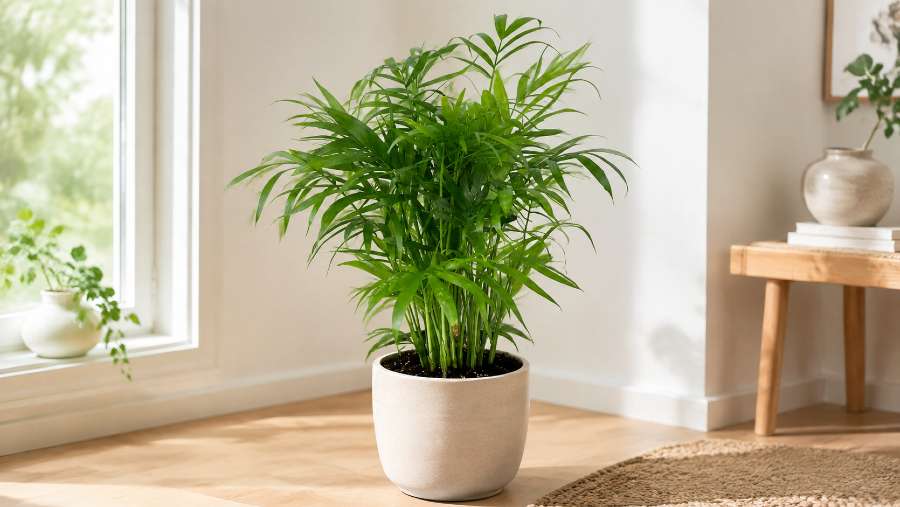
Indoor palms that stay small give you the graceful foliage of a palm without immediately taking over the room. Some remain relatively short, while others grow slowly or maintain a narrow footprint that fits more comfortably in an apartment or smaller home.
Parlor Palm is the strongest overall choice when you need a genuinely manageable indoor palm. Cat, Lady, Pygmy Date, and Bamboo Palms require a little more space, but they can still work in carefully chosen locations. Kentia Palm can eventually become tall, yet its exceptionally slow indoor growth allows it to remain manageable for many years.
The important thing is to look beyond the size of the palm at the garden center. A young palm may fit on a table today but develop a much wider spread as its fronds mature. Height, width, growth rate, light requirements, and container size all affect whether a palm will work in your available space.
This guide compares six smaller or slower-growing palms and explains where each one fits best. Every palm also links to its complete care guide, so you can check its growing requirements before making your final choice.
What You’ll Learn
- Which indoor palms remain the most manageable
- The difference between a short palm and a narrow palm
- How large each palm may become indoors
- Which choices work best in apartments and smaller rooms
- How light influences palm growth and appearance
- Which palms require additional width despite their limited height
Quick Answer: Parlor Palm is the best indoor palm for a small space because it grows slowly, tolerates moderate indirect light, and remains more manageable than most palms. Cat and Lady Palms provide fuller foliage without becoming extremely tall. Pygmy Date Palm needs stronger light and has sharp spines, while Bamboo Palm stays relatively narrow but can become tall. Kentia Palm is not genuinely small, but its extremely slow growth makes it a practical long-term choice when you have adequate ceiling height.
Indoor Palms That Stay Small at a Glance
| Palm | Typical Indoor Size | Best Light | Space Advantage | Care Level |
|---|---|---|---|---|
| Parlor Palm | 2–6 feet | Moderate to bright indirect | Best overall compact choice | Easy |
| Cat Palm | 3–6 feet | Bright indirect | Limited height with full foliage | Moderate |
| Lady Palm | 4–8 feet | Moderate to bright indirect | Slow growth and upright form | Easy to moderate |
| Pygmy Date Palm | 4–8 feet | Very bright indirect light | Compact compared with larger date palms | Moderate |
| Bamboo Palm | 4–8 feet | Moderate to bright indirect | Relatively narrow, upright growth | Moderate |
| Kentia Palm | 6–10 feet eventually | Moderate to bright indirect | Extremely slow indoor growth | Easy to moderate |
Mature indoor size: These size ranges are practical estimates rather than permanent limits. Light, palm age, container size, cultivar, and growing conditions affect the final height and spread. Container growing slows growth, but it does not genetically transform a larger palm into a miniature plant.
What Does “Stay Small” Mean for an Indoor Palm?
The word small can be misleading when discussing palms. A palm may remain short but develop broad, arching fronds. Another may grow tall while maintaining a relatively narrow footprint. A third may eventually become large but grow so slowly that it remains manageable for many years.
For this guide, a smaller indoor palm offers at least one of the following advantages:
- A mature indoor height that commonly remains around 6 feet or less
- An upright or relatively narrow growth habit
- Slow growth that delays the need for additional space
- The ability to grow in a manageable container
- A size better suited to apartments and ordinary rooms than large specimen palms
Parlor Palm comes closest to meeting all these requirements. Cat Palm remains relatively short but becomes broad. Bamboo Palm has an upright form but may grow taller. Kentia Palm is included because of its exceptionally slow growth, although it should not be treated as a permanently compact palm.
Quick Tip: Measure both the available floor area and the width at frond height. Palm foliage often extends well beyond the edges of the container, so pot size alone does not tell you whether the plant will fit.
1. Parlor Palm
Chamaedorea elegans
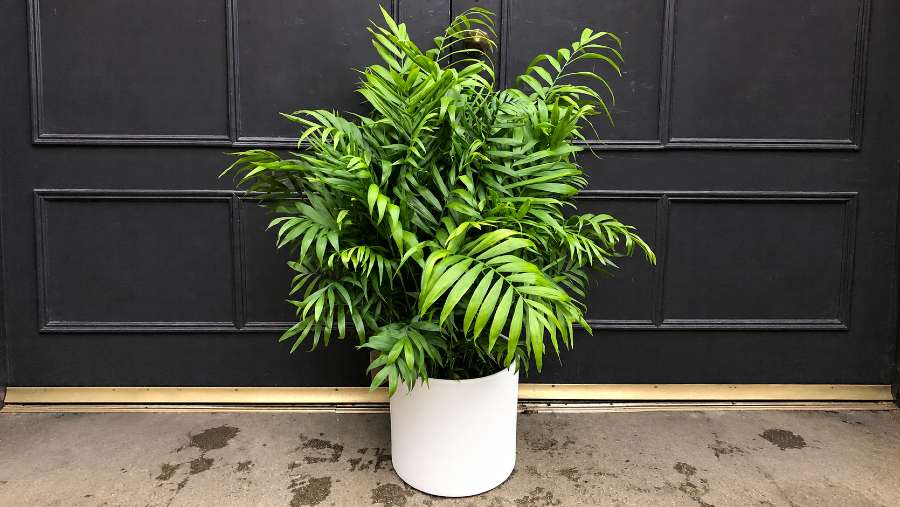
Parlor Palm is the best overall choice when you want an indoor palm that stays relatively small. It grows slowly, adapts to ordinary household conditions, and tolerates moderate indirect light better than many larger palms.
Young Parlor Palms are commonly sold as tabletop plants. Several seedlings are usually grouped in one container to create a fuller appearance. As the palm matures, it can move to a plant stand and eventually become a modest floor plant.
Its fine, arching fronds create a graceful palm appearance without the massive leaf spread produced by Areca, Majesty, Fishtail, and Chinese Fan Palms. This makes it easier to place beside furniture, near a bright window, or in an apartment living room.
Typical indoor size: Parlor Palm commonly grows approximately 2–6 feet tall indoors. Growth is slow, and a young specimen may remain suitable for a table or plant stand for several years. Mature width depends heavily on the number of plants growing together in the container.
Best Placement for a Parlor Palm
Place a Parlor Palm where it receives moderate to bright indirect light. It tolerates lower light better than most palms, but brighter filtered light generally supports fuller, stronger growth.
A location near an east-facing window often works well. You can also position it near a brighter south- or west-facing window when a sheer curtain or sufficient distance protects the foliage from intense afternoon sun.
Parlor Palm is a particularly useful choice for:
- Small apartments
- Bedrooms with usable natural light
- Home offices
- Plant stands and side tables
- Smaller living rooms
- Spaces that cannot accommodate broad palm fronds
Why Parlor Palm Works in Small Spaces
Parlor Palm combines slow growth, adaptable care, and a relatively compact form. It also tolerates brief periods of slight dryness better than moisture-loving Cat Palm. This makes it more forgiving when indoor conditions or watering routines are not perfect.
Avoid placing it in a windowless room simply because it is described as a low-light palm. Low-light tolerance does not mean that the plant can live indefinitely without meaningful natural or supplemental light.
Read the complete Parlor Palm indoor care guide.
2. Cat Palm
Chamaedorea cataractarum
![Cat Palm Care Indoors [Chamaedorea Cat Palm Growth Tips]](https://www.indoorvegetablegrower.com/wp-content/uploads/Chamaedorea_cataractarum_kz2.jpg)
Cat Palm is a good option when you want a full, leafy palm that does not normally develop a tall central trunk indoors. It grows as a dense clump of stems emerging near soil level, producing a lush fountain of arching green fronds.
This palm remains fairly limited in height compared with many specimen palms. However, it needs more horizontal room than Parlor Palm. Its expanding clump and arching foliage make it better for an open corner than a narrow shelf or crowded walkway.
Typical indoor size: Cat Palm commonly reaches approximately 3–6 feet tall and can become equally wide under favorable conditions. Its height may suit a smaller home, but you should allow enough open floor space for the fronds to spread.
Best Placement for a Cat Palm
Cat Palm performs best in bright indirect light. Position it reasonably close to a bright window while protecting foliage from sudden exposure to harsh direct sunlight.
It appreciates more consistent moisture and humidity than Parlor Palm. Keep it away from heating vents, air-conditioning outlets, and drafty exterior doors that can dry the foliage or cause abrupt temperature changes.
Cat Palm works especially well in:
- An open living-room corner
- A bright bedroom with adequate floor space
- A plant grouping near a humidifier
- A wide entry area that does not restrict the fronds
- A bright bathroom with a suitable window
Why Cat Palm Works in Small Homes
Cat Palm provides the visual impact of a much larger palm without commonly reaching the ceiling. Its dense foliage can fill an empty corner and create a strong plant focal point.
The tradeoff is width. Cat Palm is compact vertically rather than compact in every direction. Measure the available area carefully and avoid placing it where people will repeatedly brush against the fronds.
Read the complete Cat Palm indoor care guide.
3. Lady Palm
Rhapis excelsa
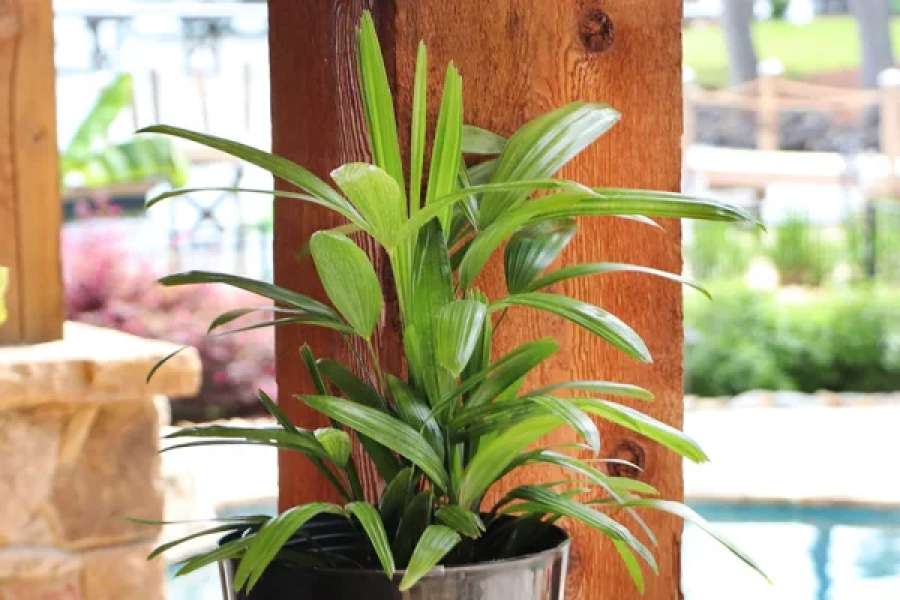
Lady Palm is a slow-growing indoor palm with upright, cane-like stems and broad, fan-shaped leaves. Its growth habit is more structured than the soft, arching form of Parlor or Cat Palm, making it useful when you want attractive foliage without fronds extending far into the room.
A mature Lady Palm is not a tabletop plant. However, its slow growth and relatively upright form make it more manageable than Areca, Majesty, Fishtail, and Chinese Fan Palms. It can remain an attractive floor plant for many years when given suitable light and regular care.
Lady Palms grow as clumps of stems emerging from underground rhizomes. The clump gradually expands, but its growth can be managed by dividing the plant when it becomes crowded. This gives you more control over its width than you have with a single-trunk palm.
Typical indoor size: Lady Palm commonly grows approximately 4–8 feet tall indoors. Its final width depends on the number of stems in the container and how long the clump is allowed to expand.
Best Placement for a Lady Palm
Place Lady Palm in moderate to bright indirect light. It adapts to moderate indoor light, but stronger filtered light usually produces denser growth and helps prevent the plant from leaning toward the window.
Its upright stems make it a good choice for locations that have adequate ceiling height but limited floor width. Avoid squeezing the palm into a narrow walkway where its fan-shaped leaves will be repeatedly bumped or damaged.
Lady Palm can work well in:
- Living-room corners
- Home offices
- Bright entry areas
- Spaces beside bookcases or cabinets
- Rooms with moderate light and adequate ceiling height
- Containers used as structured floor displays
Why Lady Palm Works in Smaller Rooms
Lady Palm grows slowly and maintains a more upright profile than many feather-leaved palms. The individual stems create height without requiring the broad, arching spread associated with an Areca or Majesty Palm.
Its clumping growth also gives you some flexibility. An established plant can be divided if it becomes too wide for its container or location. Division should be done carefully because unnecessary root disturbance can temporarily slow growth.
Read the complete Lady Palm care guide.
4. Pygmy Date Palm
Phoenix roebelenii
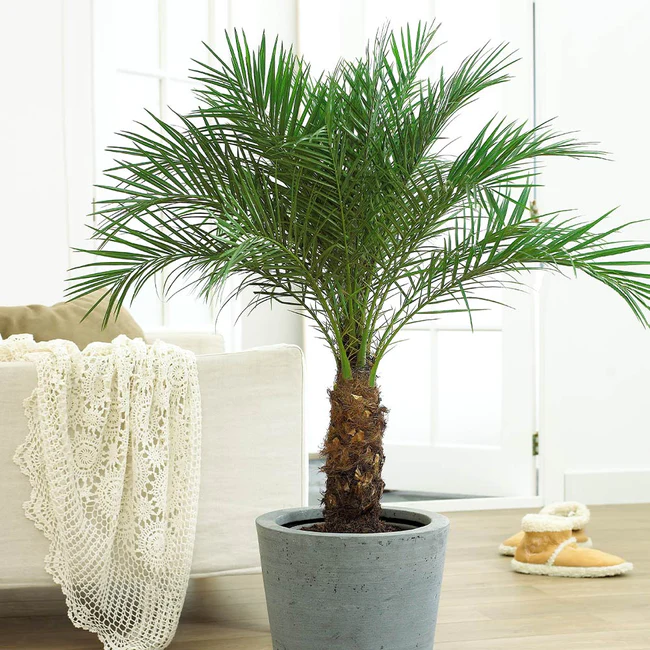
Pygmy Date Palm offers the classic appearance of a date palm in a more compact form. It develops a slender trunk topped by arching, finely divided fronds. Although it remains smaller than many other date palms, it needs considerably stronger light than Parlor, Lady, or Bamboo Palm.
Garden centers often sell several Pygmy Date Palms growing together in one container. This creates a full, multi-trunk appearance, but it also increases the plant’s overall width. A single-trunk specimen requires less floor space than a container holding three or more palms.
This is a better choice for a sunny room or bright window area than for a dim apartment corner. Weak light can lead to thin growth, declining older fronds, and a palm that gradually loses its attractive shape.
Typical indoor size: Pygmy Date Palm commonly grows approximately 4–8 feet tall indoors. Its fronds can spread several feet, especially when multiple plants share the same container.
Best Placement for a Pygmy Date Palm
Position Pygmy Date Palm near a very bright window. It can tolerate some gentle direct sun after gradual acclimation, but a palm previously grown under filtered nursery light can scorch if it is suddenly exposed to intense afternoon sunlight.
Allow open space around the base and foliage. Pygmy Date Palm has sharp spines near the lower portions of its fronds. These can injure a person or pet that brushes against the plant.
Useful locations include:
- A bright sunroom
- A wide area near a south- or west-facing window
- A bright living room with open floor space
- A protected seasonal patio or balcony display
- An area away from children, pets, and walkways
Why Pygmy Date Palm Can Work in Limited Space
Pygmy Date Palm remains much smaller than the large date palms used in outdoor landscapes. Its trunk also gives it a more vertical appearance than a dense clumping palm.
However, this is not the best choice for every apartment. It needs strong light, its arching fronds require room, and the sharp spines complicate placement. Choose it when you want a distinctive palm and have a bright, low-traffic location rather than simply because the word pygmy appears in its name.
Placement Warning: Do not position a Pygmy Date Palm beside a chair, doorway, narrow hallway, or children’s play area. Its lower frond spines can be surprisingly sharp.
Read the complete Pygmy Date Palm indoor care guide.
5. Bamboo Palm
Chamaedorea seifrizii
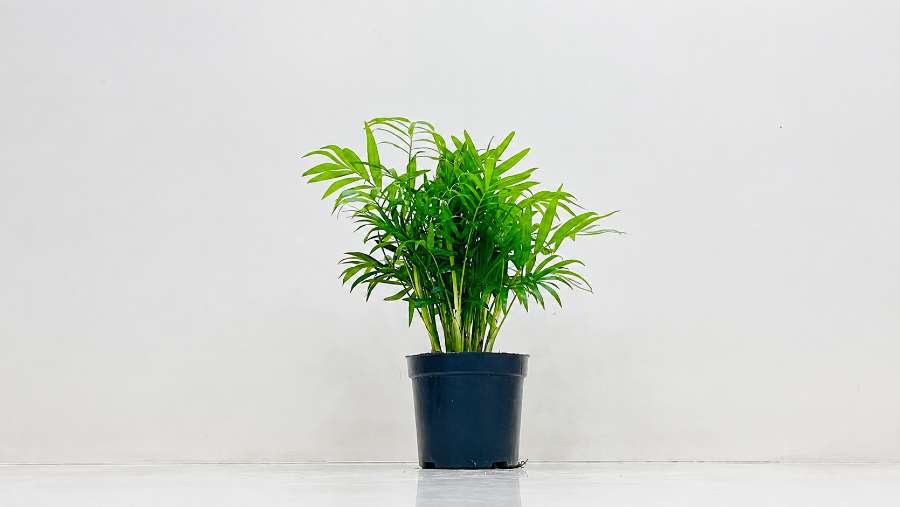
Bamboo Palm develops multiple slender stems that resemble bamboo canes. Each cane supports feathery green fronds, creating a tall but relatively narrow screen of foliage.
This palm is not particularly short at maturity. Its advantage is its upright growth habit. A Bamboo Palm can provide height and fullness without occupying as much horizontal space as a broad Areca, Majesty, or Fishtail Palm.
Bamboo Palm is useful when you have adequate ceiling height but limited floor area. It can also create a soft visual screen between different parts of a room without requiring a heavy or bulky planter arrangement.
Typical indoor size: Bamboo Palm commonly reaches approximately 4–8 feet tall indoors. Its clump gradually expands, although the upright canes usually maintain a more contained profile than the arching fronds of many larger palms.
Best Placement for a Bamboo Palm
Place Bamboo Palm in moderate to bright indirect light. It can adapt to moderate light, but it should not be expected to remain dense and healthy in a dark or windowless room.
This palm appreciates consistent moisture and moderate humidity. Keep it away from heating vents and other sources of excessively dry air. A humidifier can be helpful during winter if the leaf tips begin turning brown.
Bamboo Palm is particularly useful for:
- Narrow living-room corners
- Bright home offices
- Creating a soft room divider
- Filling vertical space beside a window
- Adding height without an extremely broad canopy
- Grouping with shorter houseplants
Why Bamboo Palm Works in Smaller Homes
Bamboo Palm uses vertical space efficiently. Its slender canes and upright form make it easier to accommodate than a palm with a single thick trunk and a wide crown.
It should still be treated as a floor plant rather than a permanently compact palm. Before purchasing one, measure the ceiling height and the width available around the foliage. A healthy specimen can become tall even when its footprint remains reasonably contained.
Read the complete Bamboo Palm indoor care guide.
6. Kentia Palm
Howea fortepiano
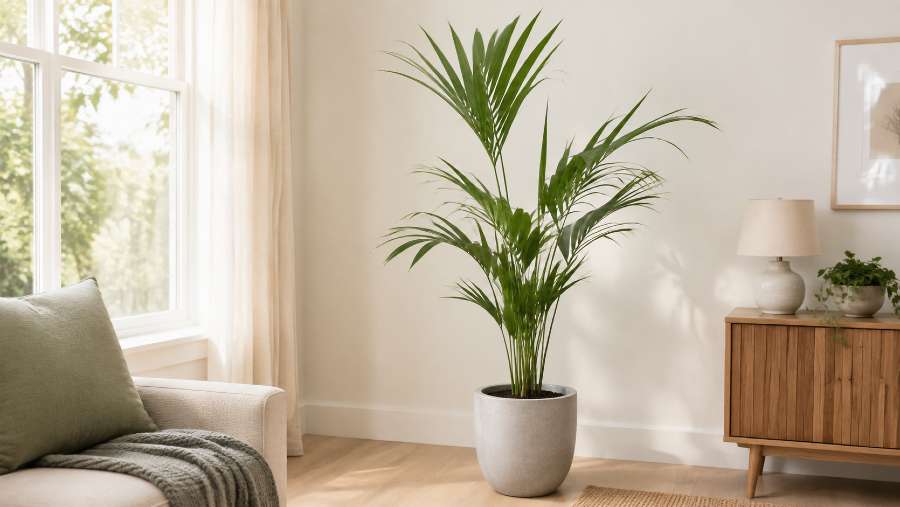
Kentia Palm is the exception on this list. It is not a genuinely small palm, and a mature specimen can eventually become an impressive floor plant. It is included because it grows extremely slowly indoors and can remain manageable for many years.
Its graceful, arching fronds create an elegant display without the dense, bushy appearance of an Areca or Cat Palm. Young Kentia Palms can fit comfortably in ordinary living rooms, offices, and bedrooms when given enough room for their fronds.
Kentia Palm also adapts to indoor conditions better than many large palms. It tolerates moderate indirect light, average household temperatures, and brief periods of slight dryness once established. This adaptability helps it maintain an attractive appearance without extremely rapid growth.
Typical indoor size: Kentia Palm can eventually grow approximately 6–10 feet tall or more indoors. Reaching that size may take many years. Its slow growth is the reason it can serve as a manageable long-term palm rather than a permanently compact one.
Best Placement for a Kentia Palm
Place Kentia Palm in moderate to bright indirect light. It handles moderate indoor light better than Areca, Majesty, Fishtail, and Pygmy Date Palms, although stronger filtered light supports healthier and more balanced growth.
Allow space for its fronds to arch naturally. Pushing the palm tightly against a wall or placing it in a busy walkway can damage the foliage and make the plant appear crowded.
Kentia Palm works best in:
- Living rooms with adequate ceiling height
- Bright bedrooms with an open corner
- Home offices that need a slow-growing floor plant
- Rooms where a broad but uncluttered palm form is desirable
- Spaces intended to accommodate the same plant for many years
Why Kentia Palm Is Included
Kentia Palm belongs in this guide because growth rate matters almost as much as final size. A fast-growing palm may outgrow a room quickly, while a Kentia Palm can remain suitable for its location for a long time.
This does not mean container restriction will keep it small forever. Choose Kentia Palm when you have enough vertical space for future growth and want a palm that develops gradually. If your location has a strict height limit, Parlor Palm is the safer choice.
Kentia Palm Reality Check: Kentia Palm is slow-growing, not miniature. It works in this selection because it remains manageable for a long time, but it may eventually need more height and width than the other palms in this guide.
Read the complete Kentia Palm indoor care guide.
How to Choose the Best Small Indoor Palm
Start with the conditions in your home rather than choosing solely by appearance. A palm that matches your light and available space will remain attractive longer and require fewer corrections later.
| Your Priority | Best Choice | Why It Fits |
|---|---|---|
| Smallest overall palm | Parlor Palm | Slow-growing, adaptable, and suitable for tables or floors |
| Fullest foliage without excessive height | Cat Palm | Forms a dense, trunkless clump but needs room to spread |
| Upright fan-shaped foliage | Lady Palm | Slow-growing with upright stems and manageable clumping growth |
| Brightest location | Pygmy Date Palm | Provides a classic trunked-palm appearance in strong light |
| Narrow vertical display | Bamboo Palm | Slender canes use vertical space efficiently |
| Slow-growing statement palm | Kentia Palm | Develops very slowly but eventually needs considerable height |
Decision Framework: Choose for light first, mature width second, and growth rate third. Parlor Palm is the safest overall choice when several palms could fit your conditions.
Best Indoor Palms for Low Light
If your space has genuinely low natural light, such as a north-facing window, a dim corner near a window, or a hallway that still receives some daylight, these three palms are the most dependable choices:
- Parlor Palm — the best overall choice for lower indoor light
- Kentia Palm — slow-growing and adaptable, but eventually becomes tall
- Lady Palm — tolerates moderate light and maintains an upright form
Important: Low-light tolerance does not mean that a palm can grow indefinitely without usable light. A windowless hallway or dark interior corner will require a suitable grow light. Even these adaptable palms usually grow more slowly and less densely in low light.
Measure Your Available Palm Space
Measure more than the empty area on the floor. You also need to consider the palm’s future height and the distance its fronds may extend beyond the container.
Check these measurements before purchasing a palm:
- Floor width: Measure the open area around the container.
- Frond width: Allow room for foliage to arch beyond the pot.
- Ceiling height: Include the height of the container and plant stand.
- Window distance: Confirm that the palm can remain close enough to usable light.
- Walking clearance: Keep foliage and sharp spines out of busy pathways.
- Future growth: Leave room for the palm to mature without immediate relocation.
A Cat Palm may fit beneath your ceiling but become too wide for a narrow corner. A Bamboo or Kentia Palm may have a more manageable footprint but eventually require additional height. Looking at all three dimensions prevents an unpleasant surprise after the palm settles into your home.
Shared Care for Smaller Indoor Palms
These six palms have different preferences, but several shared practices provide a useful starting point. Always adjust your care according to the individual species and the conditions in your home.
Light
Parlor, Lady, Bamboo, and Kentia Palms tolerate moderate indirect light. Cat Palm generally performs better with brighter indirect light, while Pygmy Date Palm needs the strongest light of the six.
Indoor light decreases quickly as you move away from a window. A palm placed across the room receives far less usable light than one positioned reasonably close to the glass.
If your chosen location does not provide meaningful natural light, use a suitable grow light rather than expecting an ordinary ceiling fixture to support the palm indefinitely.
Watering
Check the growing medium below the surface before watering. Most indoor palms prefer lightly moist conditions with enough drainage to prevent the root zone from remaining saturated.
Parlor, Lady, and Kentia Palms tolerate brief periods of slight dryness better than Cat and Bamboo Palms. Pygmy Date Palm also needs careful drainage and should not remain in waterlogged soil.
Watering frequency changes with light, temperature, container size, palm size, and the growing medium. Use the condition of the root zone instead of following a fixed weekly schedule.
Potting Mix
A loose, moisture-retentive growing medium helps provide both moisture and oxygen around the roots. Buffered coco coir and coarse perlite provide a practical starting point:
- 2 parts buffered coco coir
- 1 part coarse perlite
- Optional fine orchid bark for additional airflow
Adjust the proportions according to the palm and your watering habits. Cat and Bamboo Palms may benefit from a slightly more moisture-retentive mixture, while Pygmy Date Palm requires especially dependable drainage.
Humidity and Temperature
Average household humidity may be adequate for Parlor, Lady, and Kentia Palms. Cat and Bamboo Palms are more likely to develop brown tips when heated winter air becomes extremely dry.
A humidifier produces a more dependable increase in humidity than occasional misting. Keep every palm away from heating vents, air-conditioning outlets, cold drafts, fireplaces, and frequently opened exterior doors.
Fertilizing
Feed palms carefully during active spring and summer growth. Use a fertilizer formulated for palms or indoor foliage plants and follow its label directions.
Slow-growing palms do not need heavy feeding. Excess fertilizer can contribute to root damage, mineral buildup, and brown leaf tips. Reduce or pause feeding when winter light is low and growth has slowed.
Can You Keep an Indoor Palm Small by Pruning It?
Pruning does not control palm height in the same way that it controls many branching houseplants. A palm grows from a central growing point. Cutting the top from a single-trunk palm can permanently damage or kill that stem.
Remove only fronds that are completely brown, badly damaged, or clearly declining. Avoid removing healthy green fronds simply to reduce the plant’s size. Those leaves help the palm produce the energy needed for continued growth.
Clumping palms such as Lady, Cat, Bamboo, and Parlor Palms provide slightly more flexibility. Individual dead or unwanted stems can sometimes be removed at the base, and an established clump may be divided when it becomes too wide. This manages density, but it does not transform a naturally tall species into a miniature palm.
Does a Small Container Keep a Palm Small?
A container can slow growth, but keeping a palm severely root-bound is not a healthy long-term size-control method. Crowded roots may struggle to absorb water and nutrients, causing weak growth, rapidly drying soil, yellowing foliage, and damaged leaf tips.
Repot only when the palm genuinely needs additional root space. Move it into a container one size larger rather than placing a small root system in an oversized pot. A modest increase provides room for growth without surrounding the roots with an excessive amount of wet growing medium.
Common Mistakes with Small Indoor Palms
- Judging mature size by the palm’s size at the store
- Measuring the container without allowing for the frond spread
- Assuming that low-light tolerance means no natural light is required
- Selecting Pygmy Date Palm for a dim room
- Placing the sharp spines of a Pygmy Date Palm near a walkway
- Expecting a Kentia Palm to remain permanently short
- Keeping the growing medium constantly saturated
- Allowing moisture-loving Cat or Bamboo Palms to dry completely
- Repotting a slow-growing palm into an oversized container
- Cutting healthy green fronds in an attempt to control height
- Applying extra fertilizer to correct a problem caused by inadequate light
Are Small Indoor Palms Safe for Cats and Dogs?
Pet safety depends on the exact botanical name. The ASPCA lists Parlor Palm as non-toxic to cats and dogs. It also lists Pygmy Date Palm as non-toxic to cats and dogs.
Non-toxic does not mean that pets should be encouraged to chew the foliage. Consuming plant material can still cause digestive upset, and chewing can badly damage a slow-growing palm.
Pygmy Date Palm presents an additional physical concern. Its lower fronds have sharp spines that can injure curious pets even though the plant is not considered toxic.
Confirm the scientific name of any palm before bringing it into a home with pets. Plants sold under similar common names may be unrelated. Sago Palm is particularly important to recognize because it is a toxic cycad rather than a true palm.
Check the ASPCA plant database or ask your veterinarian about the exact species when you are uncertain.
Frequently Asked Questions
What is the smallest indoor palm?
Parlor Palm is the smallest and most manageable palm in this selection. Young plants can grow on a table or plant stand, while mature specimens usually remain considerably smaller than Areca, Majesty, Fishtail, and Chinese Fan Palms.
What is the best small palm for an apartment?
Parlor Palm is the best overall choice for an apartment. It grows slowly, tolerates moderate indirect light, and needs less floor space than most indoor palms. Lady Palm is another good option when you want a taller, more upright floor plant.
Which small indoor palm handles lower light best?
Parlor, Lady, and Kentia Palms tolerate moderate or lower indoor light better than the other choices in this guide. They still need usable natural or supplemental light and will not grow well indefinitely in a windowless room.
Which indoor palm has the narrowest growth?
Bamboo Palm has one of the most upright growth habits. Its slender canes use vertical space efficiently, although the plant can eventually reach 4–8 feet tall. Lady Palm is another useful choice when you need upright foliage and slow growth.
Can a Kentia Palm stay small indoors?
Kentia Palm grows extremely slowly indoors, so it can remain manageable for many years. However, it is not a permanently small palm. A mature specimen can eventually reach 6–10 feet or more and develop long, arching fronds.
Can you cut the top off an indoor palm to keep it short?
Do not cut the central growing point from a single-trunk palm. Palms do not branch after topping like many woody plants, and removing the growing point can permanently damage or kill the stem.
Do small indoor palms need direct sunlight?
Most of these palms perform well in moderate to bright indirect light. Pygmy Date Palm needs the brightest location and may tolerate some gentle direct sun after gradual acclimation. Parlor, Lady, Bamboo, Cat, and Kentia Palms generally do well with filtered light appropriate for the species.
Why is my small palm developing brown tips?
Brown tips can result from dry air, inconsistent watering, fertilizer buildup, damaged roots, or excessively dry growing medium. Check the complete growing environment before assuming that low humidity is the only cause.
Final Thoughts
Parlor Palm is the strongest overall choice when you need an indoor palm that stays small. It grows slowly, adapts to moderate indirect light, and fits more easily into apartments and ordinary rooms.
Cat Palm provides fuller foliage without becoming extremely tall, although it needs additional width. Lady Palm offers upright fan-shaped leaves and slow growth. Pygmy Date Palm brings a classic trunked-palm appearance to bright rooms, while Bamboo Palm uses vertical space efficiently.
Kentia Palm remains a worthwhile choice when you understand the tradeoff. It does not remain permanently small, but its extremely slow growth can keep it manageable for many years.
Measure your floor space, frond clearance, ceiling height, and available light before choosing. Once those conditions are clear, finding the right palm becomes much easier.
Continue Exploring Indoor Palms
Find the right palm and learn how to keep it growing:
- Best Indoor Palm Trees: 10 Choices for Real Homes
Compare compact palms with larger statement palms for bright rooms and open spaces. - Indoor Palm Tree Care: Complete Guide for Beginners
Learn the shared light, watering, humidity, potting, and maintenance needs of indoor palms. - Parlor Palm Indoor Care
Start with the most manageable palm for apartments and smaller rooms. - Kentia Palm Indoor Care
See how to grow this elegant, exceptionally slow-growing floor palm.
References
- Penn State Extension: Palms as Houseplants
- Clemson Cooperative Extension: Indoor Palms
- University of Minnesota Extension: Lighting for Indoor Plants
- Clemson Cooperative Extension: Indoor Plant Soil Mixes
 Steve S. is the creator of