
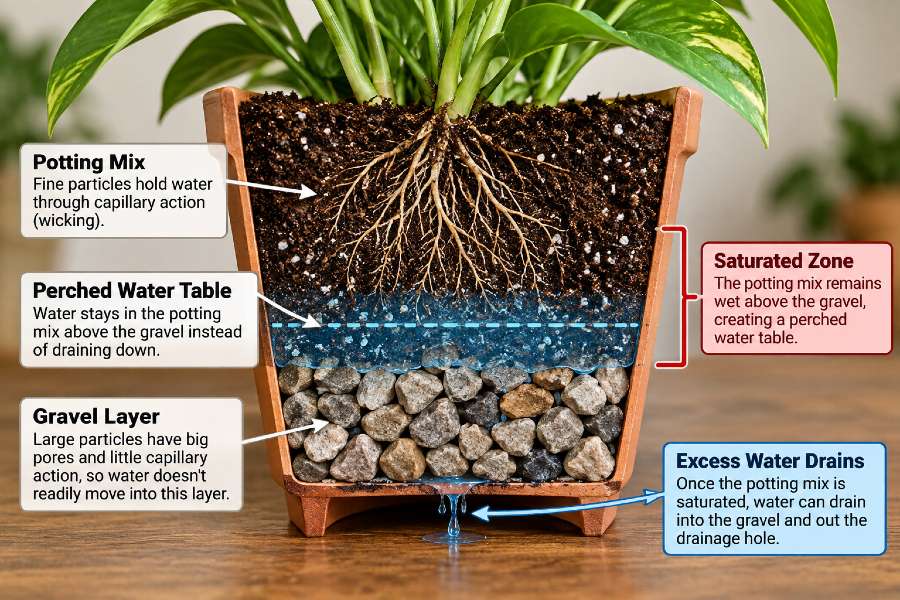
So here’s another common myth that I see repeated on gardening sites all the time: They say to add gravel or broken pottery bits to the bottom of your pot to improve drainage.
It seems like this would work, but actually nothing could be further from the truth. It’s actually something that makes drainage worse because it creates what’s called a perched water table.
So the water stays in the finer medium rather than draining down to the thicker medium. The perched-water effect is mainly about capillary forces and the difference in pore size between the fine potting medium and the coarse gravel layer.
The way soil works is wicking action moves moisture through the soil. If you have large chunks down at the bottom, you have less wicking action, so the water tends to actually stay in the finer potting medium. So it’s actually counterproductive.
The thing you want to make sure of is never use a pot that does not have drainage holes. If you want to use a decorative ceramic pot, use it as a catch pot. Place a pot with drainage holes inside it. That way you can water your plant, it can drain—just make sure you don’t leave standing water in the catch pot.
Now let’s take a closer look at why gravel in the bottom of pots doesn’t work the way you might expect.
What You’ll Learn
- Why gravel in bottom of pots doesn’t improve drainage.
- What a perched water table is and why it forms.
- Why water doesn’t simply flow from fine potting mix into coarse gravel.
- Why broken pottery and rocks can cause the same problem.
- What actually helps improve drainage around plant roots.
- How to safely use decorative pots without drainage holes.
Quick Answer: Does Gravel in Bottom of Pots Improve Drainage?
No. Putting gravel in bottom of pots doesn’t improve drainage and can actually leave the saturated portion of the potting mix higher in the container. Water moving through fine potting mix doesn’t immediately move into a much coarser layer of gravel. Instead, capillary forces can hold water in the finer material above the gravel until the potting mix becomes sufficiently saturated for water to move into the coarse layer below.
In other words, the gravel doesn’t eliminate the wettest part of the potting mix. It can simply move it higher in the pot.
Gravel in Pots at a Glance
| Question | What Actually Happens |
| Does gravel improve drainage? | No. A gravel layer can cause water to remain in the finer potting mix above it. |
| What causes this? | Capillary forces and the large difference in pore size between fine potting mix and coarse gravel. |
| What is a perched water table? | A saturated zone of growing medium that remains above the coarse gravel layer. |
| What about broken pottery? | A substantial layer of pottery shards, rocks, or other coarse material can create the same basic problem. |
| What should I use instead? | Use an appropriate, well-aerated potting medium in a container with drainage holes. |
| Can I use a decorative pot without holes? | Yes. Use it as a cachepot with a draining nursery or growing pot inside and empty excess water after watering. |
Why Gravel in Bottom of Pots Seems Like It Should Work
I can understand why this advice has lasted for so long. If you’ve ever poured water through a pile of gravel, it drains right through. So it seems logical that putting gravel underneath potting mix would give excess water somewhere to go.
The problem is that we’re not dealing with gravel by itself. We’re putting two materials with very different particle sizes and pore spaces on top of one another.
Potting mix contains relatively small pore spaces that can hold and move water through capillary action. Gravel has much larger spaces between the particles. When those two layers meet, water doesn’t necessarily leave the fine material and immediately drop into those larger spaces below.
Instead, water can remain in the finer potting medium until enough water accumulates for gravity to overcome the forces holding it there.
That’s how you can end up with a saturated area of potting mix sitting directly above a layer that looks like it should be providing excellent drainage.
What Is a Perched Water Table in a Plant Pot?
The term sounds more complicated than the idea really is.
After you thoroughly water a container and excess water drains away, some water remains in the growing medium. The smallest pore spaces hold onto water through capillary forces while the larger pores contain more air.
When you suddenly place a layer of much coarser material underneath that fine potting medium, you create a sharp change in pore size. Water can remain in the fine material above that boundary rather than readily moving into the much larger spaces in the gravel.
That’s the perched water table we’re talking about.
And here’s the part that makes the old advice so counterproductive: adding gravel doesn’t necessarily make that saturated zone disappear. It can move it higher in the container, where more of your plant’s roots may be growing.
University of Maine Gives a Great Explanation
The University of Maine Cooperative Extension has one of the clearest explanations I’ve found for what happens inside the pot.
They explain that water doesn’t move easily from the small pore spaces in potting mix into the larger pore spaces of gravel. The finer material above the gravel has to become more saturated before the water moves into that coarse layer below.
They also point out the practical consequence: adding coarse material to the bottom of the container can actually move the perched water table higher.
That’s almost the exact opposite of what we’re trying to accomplish when we put gravel in the bottom of a pot.
We thought we were creating more drainage. Instead, we’ve reduced the depth of usable potting medium and moved the wettest portion of that medium closer to the roots.
Why a Gravel Layer Can Actually Make Things Worse
There’s another way to look at this that makes the problem pretty easy to understand.
Your pot only has so much vertical space. If you fill the bottom couple of inches with gravel, rocks, or broken pottery, you’ve taken away a couple of inches that could have been filled with potting medium.
But you haven’t eliminated the wettest portion of the potting mix. You’ve simply raised the bottom of the potting mix higher in the container.
That means you can end up with less room for roots while still having a saturated zone at the bottom of the growing medium.
That’s why adding a drainage layer is counterproductive. If your goal is to give roots a good balance of moisture and oxygen, you don’t improve things by sacrificing part of the container to a layer of gravel.
Broken Pottery Doesn’t Solve the Problem Either
Gravel isn’t the only material you’ll see recommended. Another old piece of gardening advice is to put broken pieces of terracotta pots, sometimes called crocks, in the bottom of a container.
If you’re filling a significant portion of the bottom of the pot with broken pottery, you’re creating the same basic problem. You’ve put a coarse layer underneath a finer growing medium.
That’s different from placing a single piece of broken pottery loosely over a large drainage hole to help keep potting mix from falling out. You’re not trying to build a drainage layer in that situation.
Personally, I don’t think you normally need to do even that with modern pots and potting mixes. A little potting mix coming through the drainage holes when you first fill a container isn’t much of a problem.
Good Drainage Starts With the Potting Medium
If you really want better drainage, this is where I think you should put your attention.
Use a growing medium that gives the roots a good balance between water and air.
I grow a lot of my plants in coco coir mixed with perlite. That’s something you’ve probably seen me mention many times. Coco holds moisture well, while the perlite adds larger pore spaces and helps keep the root zone aerated.
The important difference is that I’m mixing those materials together throughout the root zone. I’m not putting a layer of perlite or rocks underneath a finer material and expecting that bottom layer to somehow pull excess water out of the potting mix above it.
Different plants may need different mixes. An orchid, fern, succulent, Dracaena, and Nepenthes aren’t necessarily going to be happiest in exactly the same growing medium.
But the basic idea is the same: build the drainage and aeration into the growing medium rather than trying to create a separate drainage layer at the bottom of the pot.
Drainage and Water Retention Aren’t Opposites
This is something that can be confusing when you first start thinking about how potting mixes actually work.
A good growing medium doesn’t have to dry out immediately to have good drainage. In fact, you usually want it to retain some moisture for the roots while also containing enough air-filled pore space for healthy root growth.
That’s one reason I like coco coir. It can hold quite a bit of water and still provide a useful root environment when it’s combined with something like perlite and managed properly.
So when I talk about improving drainage, I’m not talking about making water disappear from the pot as fast as possible.
I’m talking about creating a root zone that can hold the moisture the plant needs without staying poorly aerated.
Your Container Needs Somewhere for Excess Water to Go
This brings me back to the practical advice from my introduction: I want a drainage hole in the pot.
When you water thoroughly, excess water needs a way to leave the container. A layer of gravel inside a pot with no drainage hole doesn’t create an exit for that water.
The water is still inside the pot.
You may have moved it underneath the potting mix for a while, but you haven’t drained anything out of the container.
That’s why I don’t consider rocks in the bottom of a pot a substitute for an actual drainage hole.
What About Decorative Pots Without Drainage Holes?
Of course, some of the nicest decorative ceramic pots don’t have drainage holes. That doesn’t mean you can’t use them.
I just wouldn’t plant directly into them.
Instead, use the decorative container as a catch pot, also commonly called a cachepot. Keep your plant in a nursery pot or another inner pot that has drainage holes and place that pot inside the decorative container.
When it’s time to water, you can remove the inner pot and water it thoroughly somewhere that allows it to drain. Let the excess water run out and then put the plant back into its decorative pot.
You can also water it while it’s sitting inside the cachepot, but if you do that, check the bottom afterward and dump out any water that collects there.
Don’t leave the inner pot sitting in standing water.
That gives you the appearance of the decorative container you want while your plant still gets the drainage it needs.
What About Pots With Just One Drainage Hole?
You don’t necessarily need a pot with a dozen holes in the bottom. One adequate drainage hole can work perfectly well.
What matters is that the hole remains open and allows excess water to escape.
If you’re worried about potting mix washing out, you can place a small piece of mesh over the hole. The goal is simply to keep the hole open without creating a thick layer of different material underneath the entire root zone.
That’s a very different thing from filling the bottom two inches of the pot with gravel.
Gravel Doesn’t Fix a Poor Potting Mix
This may be the most useful takeaway from the whole myth.
If your potting medium stays too wet, adding gravel underneath it doesn’t fix the problem.
Look at the growing medium itself. Is it too dense? Has it broken down and become compacted? Does it need more coarse material mixed throughout it? Is the pot much larger than the plant’s root system needs? Are the drainage holes blocked?
Those are the things I’d look at.
Putting a couple of inches of rocks underneath the same poorly draining potting mix doesn’t change the properties of that mix.
It just gives you a shallower pot full of it.
What Should You Put in the Bottom of a Plant Pot?
For most of my houseplants, the answer is pretty simple: more of the appropriate growing medium.
You don’t need a special drainage layer of gravel, rocks, broken pottery, or other coarse material underneath it.
Use a container with drainage holes and choose a growing medium that provides the right balance of moisture and air for the plant you’re growing. Fill the container with that medium and let the drainage holes do their job.
If you need to keep potting mix from falling through a particularly large drainage hole, a small piece of mesh can help. That’s not a drainage layer. It’s simply keeping the potting medium in the pot while still allowing water to escape.
The Real Lesson Is What’s Happening Inside the Pot
I think this is one of those gardening myths that survived for so long because it makes perfect sense when you first hear it.
Gravel drains quickly, so putting gravel underneath something that drains slowly seems like it should help.
But once you understand how water moves through materials with different pore sizes, you can see why it doesn’t work that way.
The water isn’t looking for an empty space at the bottom of the pot. It’s being held within the small pores of the potting medium by capillary forces. When it reaches that abrupt boundary between the fine medium and the much coarser gravel, it doesn’t simply fall through.
That’s what makes this such a good myth to bust. The old advice sounds logical until you look at what’s actually happening inside the container.
Frequently Asked Questions
Should I put gravel in bottom of pots?
No. Gravel in bottom of pots doesn’t improve drainage. The difference in pore size between the fine potting medium and coarse gravel can cause water to remain in the growing medium above the gravel, creating a perched water table.
Do rocks in the bottom of a planter help drainage?
No. Rocks create the same basic problem as gravel when they’re used as a coarse layer underneath finer potting medium. They also take up space that could otherwise be available for growing medium and roots.
Should I put broken pottery in the bottom of a pot?
There’s no need to create a layer of broken pottery underneath your potting mix. A single shard has traditionally been used to loosely cover a large drainage hole, but that’s different from filling the bottom of the container with pottery pieces to supposedly improve drainage.
What should I put over a drainage hole?
Usually, you don’t need anything. If the hole is unusually large and you’re losing too much potting medium through it, you can use a small piece of mesh that allows water to pass through freely.
Can I use a pot without drainage holes?
I prefer not to plant directly into containers without drainage holes. If you have a decorative pot without holes, use it as a cachepot. Put your plant in a smaller pot with drainage holes and place that inside the decorative container. Just remember to empty any standing water that collects in the bottom.
Does adding perlite improve drainage?
Perlite can improve the physical properties of a growing medium when it’s mixed throughout it. I commonly use coco coir and perlite for my own plants. That’s very different from putting a separate layer of coarse material underneath the potting mix.
Gravel in Bottom of Pots: Final Thoughts
This is a good example of why I think it’s worth questioning some of the gardening advice we’ve all heard repeated over the years.
Putting gravel or broken pottery in the bottom of a pot sounds like it should improve drainage. I can certainly understand the logic behind it.
The problem is that water doesn’t move through a container quite the way we’d expect just by looking at it.
The fine potting medium can hold water above the coarse gravel layer because of capillary forces and the difference in pore size. Instead of eliminating the wettest part of the potting medium, the gravel can move that saturated zone higher in the container.
So I keep it simple. I use a growing medium that gives my plants the balance of moisture and aeration they need, and I grow them in containers with drainage holes.
If I want to use a nice decorative pot without a hole, I use it as a catch pot and put a draining pot inside it.
Skip the gravel layer. Give the roots the extra growing space instead.
More Houseplant Myths
I’m taking a closer look at some of the houseplant advice that gets repeated online to see what actually holds up. If you enjoy separating useful growing advice from gardening myths, explore the rest of the series:
- Exploding the Winter Dormancy Myth – Why slower winter growth doesn’t necessarily mean your tropical houseplants have gone dormant.
- Do Houseplants Clean the Air? The NASA Study Myth – What the famous NASA research actually showed and how the air-cleaning claim became exaggerated.
- Gravel in the Bottom of Pots: Does It Improve Drainage? – Why adding gravel or broken pottery beneath your potting mix doesn’t improve container drainage the way many gardeners have been told.
- Humidity for Tropical Houseplants: What Actually Works? – Why misting, pebble trays, and grouping plants aren’t reliable ways to control humidity in a dry room.
References and Further Reading
If you’d like to read more about container drainage and why a gravel layer doesn’t work the way you might expect, these university resources are good places to start:
- University of Maine Cooperative Extension – Gardening in Small Spaces – Includes an especially clear explanation of why coarse material in the bottom of a container can create a perched water table.
- University of Illinois Extension – Container Drainage Options – Explains why adding gravel to the bottom of a container can cause water to perch above the coarse layer rather than improving drainage.
- University of California Agriculture and Natural Resources – Drainage in Containers – Discusses gravity, capillary action, pore size, and the movement of water through container media.
- Penn State Extension – Debunking Garden Myths – Addresses the traditional practice of adding coarse material to the bottom of containers and why it can be counterproductive.
 Steve S. is the creator of