
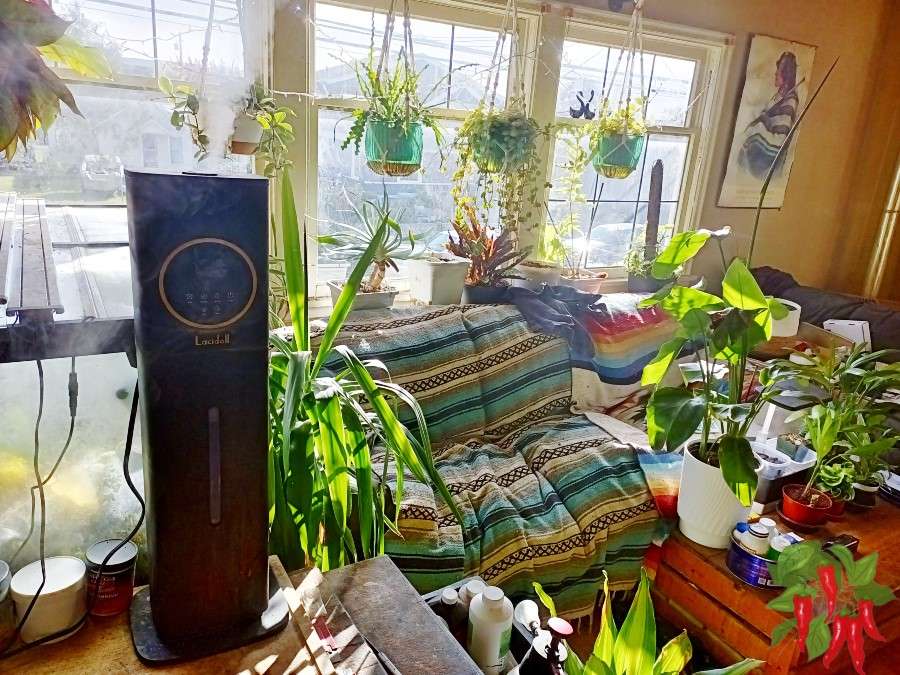
I want to continue to debunk some common gardening myths that I see online. One of the ones that I see a lot is suggestions for raising humidity for tropical houseplants.
The problem is that the things that are recommended don’t really work very well.
There are really three things I see all the time: misting your houseplants, using pebble trays, and grouping plants together. All three may have some effect on humidity, but if your plants are sitting in a dry room, they aren’t going to solve the problem.
There’s really one solution that I find works, and that’s using a room humidifier. That’s what I do in my own home, and we’ll get into that below.
What You’ll Learn
- Why misting doesn’t maintain higher humidity around your houseplants.
- Why I prefer to keep indoor plant foliage dry.
- Why pebble trays make very little difference in a dry room.
- Why grouping plants together isn’t enough when indoor humidity is low.
- How I use a room humidifier to maintain about 50% relative humidity.
- Why terrariums and enclosed growing spaces are different.
- How I acclimate greenhouse-grown plants to the lower humidity in my home.
Quick Answer: Humidity for Tropical Houseplants
If your home is genuinely dry, misting, pebble trays, and grouping plants together aren’t reliable ways to maintain higher relative humidity. Misting is temporary, a pebble tray doesn’t evaporate enough water to humidify a dry room, and grouping plants may create a small local increase from transpiration but doesn’t give you much control over humidity.
If you actually need to raise and maintain the relative humidity in a room, I find a properly sized room humidifier is the practical solution. I run mine continuously and normally aim for about 50% relative humidity for my tropical houseplants.
Humidity for Tropical Houseplants at a Glance
| Method | My Take |
| Misting | Any humidity increase is temporary and disappears as the water evaporates. I also prefer to keep indoor foliage dry. |
| Pebble trays | Water evaporates from the tray, but in a dry room the practical increase in humidity around the plant is very small. |
| Grouping plants | Plants transpire and may create a slightly more humid microclimate, but the effect is minimal when the surrounding room is dry. |
| Room humidifier | This actually adds enough moisture to the room air to raise and maintain measurable relative humidity. |
| Terrarium | A partially or fully enclosed growing space can maintain much higher humidity because you’re controlling a small volume of air. |
Why Misting Houseplants Falls Short
Misting your houseplants is probably the most common recommendation I see.
The problem with misting is that it doesn’t last very long. Once the mist dries, you’re right back to being in a dry room without enough humidity.
That’s really the problem with using misting as a way to raise humidity. You’re wetting the plant, but you aren’t doing much to control the relative humidity of the room where the plant is growing.
I Prefer to Keep Indoor Plant Foliage Dry
There’s another reason I’m not a big fan of routinely misting houseplants. Indoors, I prefer to keep the foliage dry.
Sure, plants get rained on outdoors and they’re fine. But your living room is a totally different environment.
Outdoors you have sun, wind, and much greater air movement helping the leaves dry. Indoors you usually don’t have nearly that kind of air movement, so wet foliage can stay wet much longer.
Extended leaf wetness can encourage a number of fungal and bacterial plant diseases, so I don’t see much sense in routinely wetting the leaves when misting doesn’t maintain the humidity anyway.
Here in the Pacific Northwest, I’ve certainly seen what happens when conditions are right for plant diseases. Powdery mildew can hit squash and other garden plants hard, and roses can get it too. Warm days, humid conditions, cooler nights, and poor air circulation can all help create favorable conditions for disease.
Powdery mildew is a little different from many other fungal diseases because it doesn’t necessarily require free water sitting on the leaves. But it’s still a good reminder that humidity, temperature, and air circulation all interact when it comes to plant disease.
So for everyday indoor growing, I’d rather control the humidity of the air than continually spray water onto the plant.
Pebble Trays Don’t Raise Humidity Enough
The same basic problem applies to pebble trays.
Yes, they do work somewhat because water evaporates from the tray and adds moisture to the air around the plant. I’m not saying evaporation suddenly stops working because you put water in a tray of pebbles.
The problem is that the difference they make is really negligible when the plant is sitting in a dry room.
You’ve got a relatively small surface area of water evaporating into an entire room full of dry air. That moisture doesn’t just stay in a little bubble around your plant. It mixes with the surrounding air.
So while a pebble tray technically adds some moisture to the air, I wouldn’t depend on one if I had a tropical plant that really needed higher humidity.
Grouping Plants Together Makes Only a Small Difference
The third recommendation I see all the time is grouping your plants together.
Now, plants do transpire. They give off moisture, so grouping a lot of plants together can create a somewhat more humid little microclimate among the foliage.
But again, if they’re sitting in a dry room, I don’t think they make enough of a difference to solve the problem.
The moisture those plants release is still entering the surrounding room air. Unless you’ve got an awful lot of plants in a relatively enclosed space, you don’t have much control over how high the relative humidity gets or how long it stays there.
That’s really the common problem I see with all three of these tricks. They may add a little moisture, but they don’t let you control the humidity of a dry room.
What Actually Works for Me: A Room Humidifier
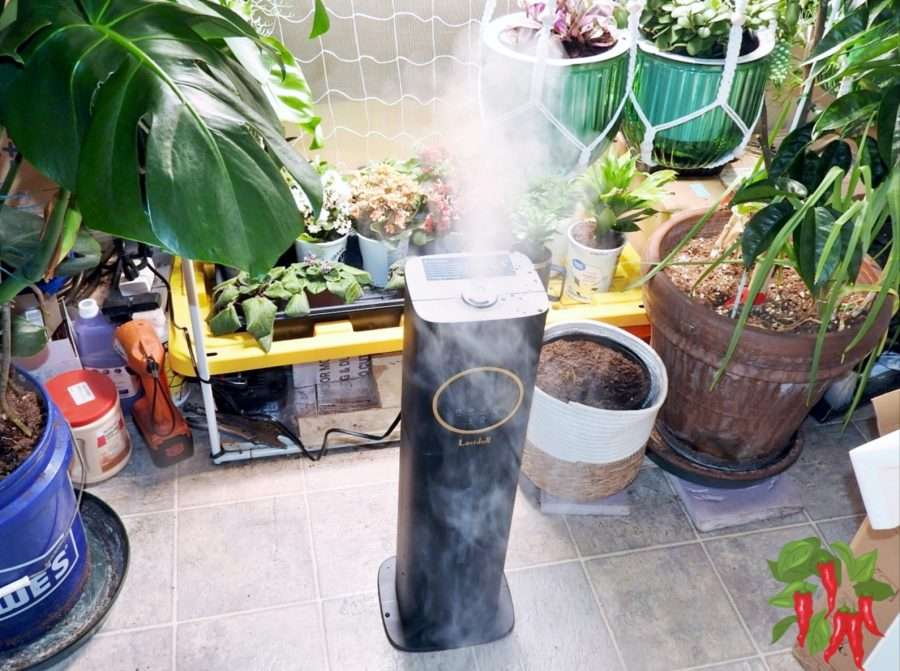
So there’s one real solution I’ve found, and that’s to use a room humidifier.
That’s what I do. I have a house full of tropical plants, and I run my humidifier 24/7. It has a large enough reservoir that I can go more than 24 hours between refills.
I try to maintain the room at about 50% relative humidity. I’ve found that most of my tropical plants do really well there.
And unlike misting, a pebble tray, or grouping a few plants together, I can actually measure the humidity and know what the room is doing.
Winter Makes Maintaining Humidity Harder
Maintaining that 50% relative humidity gets a little bit harder for me in the winter when I’m heating the house.
Here in the Pacific Northwest, our outside humidity is fairly high much of the time. But when we get a cold snap, especially in January, the air can contain much less moisture. Once that cold air comes indoors and is heated, the relative humidity drops.
At the same time, my heat is running more, so maintaining the indoor humidity becomes more difficult.
During normal winter weather, I can usually keep the room around 50%. When it gets really cold outside, sometimes I’m struggling to keep it somewhere between 40% and 50%.
But that’s doable. I’ve found that my plants handle that just fine for a few days at a time. Most of my plants do really well at around 50%, and they don’t suddenly suffer if the humidity drops below that for a short period.
Different Rooms Can Have Different Humidity
Another thing I’ve noticed is that you can’t necessarily assume the humidity is the same throughout your house.
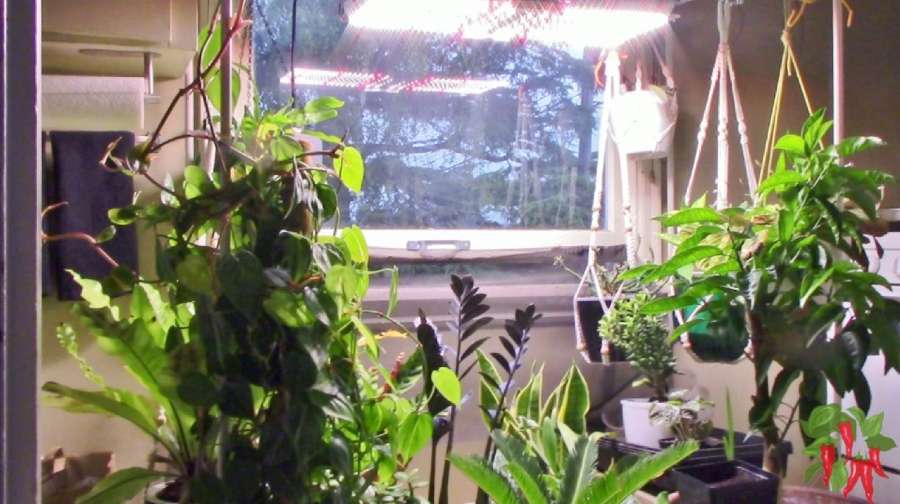
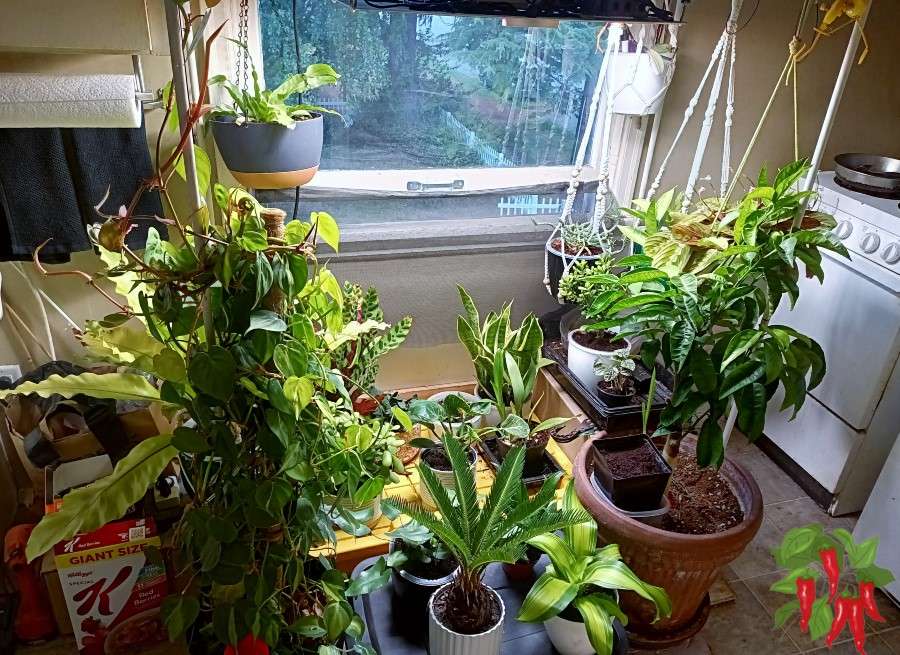
I have most of my plants in my living room, and that’s also where my main heat source is. That’s the room where I’m most concerned about relative humidity and where I run the humidifier.
I also have plants in my bedroom, but that’s farther away from the heat source. The room is naturally cooler, and the relative humidity tends to stay higher, so I don’t worry about that room nearly as much.
That’s why I think it’s better to actually measure humidity instead of assuming you have a problem because somebody online says tropical plants need more humidity.
Use a Hygrometer Instead of Guessing
A simple hygrometer will tell you what the relative humidity actually is where your plants are growing.
That’s important because relative humidity changes with temperature, weather, heating, ventilation, and even where you are in the house.
If your room is already sitting around 50% relative humidity, you may not need to do anything at all for many common tropical houseplants.
On the other hand, if your hygrometer tells you the room is sitting at 25% or 30% during the winter, misting the leaves or putting a little tray of water underneath the plant isn’t going to give you much control over that.
That’s when a humidifier starts making a lot more sense.
Terrariums Are a Completely Different Situation
Then I have my plants that are growing in terrariums, and I don’t worry about low humidity at all with them.
If anything, too much humidity can become more of a concern than not having enough.
A terrarium works because you’re dealing with a much smaller volume of air and you’re restricting how quickly moisture escapes. Water evaporates from the growing medium and plants transpire, but that moisture isn’t immediately diluted into an entire room full of dry air.
That’s very different from grouping three or four plants together on a table in an open living room.
I still like airflow in my terrariums. I don’t generally want everything sealed up tightly with stagnant air. But maintaining humidity in a terrarium is much easier than trying to maintain tropical humidity around an individual plant sitting in an open room.
Greenhouse-Grown Plants May Need Time to Acclimate
There’s another humidity issue I’ve run into that I think is worth mentioning.
I often order plants that have been grown in greenhouses, including plants shipped to me from Florida. Even though I keep my living room at around 50% relative humidity, I’ve had some of those plants arrive and start developing brown leaf edges.
You have to remember that the plant may have been growing under considerably different conditions before it arrived at your house.
That doesn’t necessarily mean 50% humidity is too low for that plant forever. It may simply need some time to acclimate to its new environment.
In that situation, I might temporarily move the plant closer to my humidifier. I may even mist it for a few days while it’s acclimating.
That may sound strange after I just spent all this time telling you that misting isn’t a good way to raise room humidity, but these are two different things.
I’m not trying to humidify the room by misting. I’m temporarily helping an individual plant adjust after moving from a humid greenhouse into my home.
How I Acclimate Nepenthes to Lower Humidity
I grow quite a few Nepenthes, and I’ve run into the same issue with them. Many of these plants have been grown under greenhouse conditions before I get them.
For those, I’ve found a simple way to acclimate them gradually.
I put a clear plastic bag over the plant to create a more humid environment around it. Then I cut holes in the bag and gradually increase the amount of air exchange over time.
As I add more openings, the humidity inside the bag gradually gets closer to the humidity in the room. Eventually I can remove the bag altogether.
I’ve found this works much better than taking a plant that’s accustomed to high greenhouse humidity and immediately expecting it to adjust to an open room.
I’ve even found that putting a newly arrived plant into an open fish tank isn’t necessarily enough. Without a cover, there’s still plenty of air exchange with the room, so the humidity may not stay high enough for a plant that’s fresh out of a greenhouse.
In that situation, I’ll use the plastic bag technique or temporarily close the top of the terrarium and gradually increase ventilation as the plant acclimates.
Again, I don’t like keeping plants tightly enclosed forever. I like airflow. The enclosure is a temporary tool to help the plant make the transition.
Acclimation and Everyday Humidity Are Two Different Things
I think this distinction gets overlooked when people talk about humidity for tropical houseplants.
A plant that has just arrived from a humid greenhouse may react to the sudden change in conditions. That’s different from a plant that has been growing successfully in your home for months or years.
For a newly arrived plant, temporarily creating a more humid microclimate and gradually increasing airflow can help it acclimate.
For my established plants, I don’t try to recreate greenhouse humidity. I maintain the room at around 50% relative humidity when I can, and most of my tropical plants grow very well under those conditions.
What About a Swamp Cooler in a Dry Climate?
If you’re in a really dry climate, such as the desert Southwest, your situation may be quite different from mine here in the Pacific Northwest.
An evaporative cooler, often called a swamp cooler, adds moisture to the air as part of the cooling process. In a hot, dry climate, that can increase indoor humidity while also cooling the room.
That’s obviously not something I’m going to use during a cold Pacific Northwest winter, but it’s another example of the same basic principle: if you want to meaningfully change room humidity, you need to add enough water vapor to change the room air.
The Humidifier Made the Difference for Me
I tried several room humidifiers before I found one that really works for me.
For my situation, reservoir size matters because I don’t want to refill the thing several times a day. I want something I can run continuously, especially during the heating season.
Once I found one with enough capacity for the room and a large enough reservoir, maintaining humidity became pretty simple.
That’s why I’m surprised I don’t see room humidifiers recommended more often when people discuss low humidity and tropical houseplants.
You’ll see mist your plants. You’ll see use a pebble tray. You’ll see group your plants together.
Those things are easy to recommend, but if the room itself is dry, none of them gives you the control that a properly sized humidifier does.
Choosing a Humidifier for Your Houseplants
If you decide you need a humidifier, the biggest thing is to get one that’s large enough for the space you’re trying to humidify.
A little desktop humidifier may put moisture into the air, but if you’re trying to maintain the humidity in a good-sized living room full of plants, it may not have enough capacity to make much difference.
Reservoir size matters too. I run mine 24/7, so I wanted something that could go at least a full day without needing to be refilled. I tried several humidifiers before I found one that worked well for my situation.
I also like being able to measure the actual relative humidity rather than simply running a humidifier and assuming it’s doing enough. That’s where a separate hygrometer comes in handy.
If your humidifier has a built-in humidistat, that’s useful too, but I still like knowing what the humidity is where the plants are actually growing.
Don’t Assume More Humidity Is Always Better
There’s another side to this. Once you start using a humidifier, you don’t necessarily want to turn your living room into a tropical greenhouse.
I’m generally happy at around 50% relative humidity. Most of my tropical houseplants grow well there, and it’s still a reasonable humidity level for my living space.
Higher humidity isn’t automatically better. Excessive indoor humidity can encourage condensation and create conditions where mold and other moisture problems become more likely in your home.
That’s another reason to use a hygrometer. You’re trying to control the humidity, not just add as much moisture to the air as possible.
Keep Your Humidifier Clean
If you’re going to run a humidifier regularly, you also need to keep it clean.
You’re putting water into a reservoir and then dispersing moisture into your living space, so this isn’t something I’d fill up and forget about for weeks at a time.
Follow the cleaning instructions for your particular humidifier, change the water regularly, and clean the reservoir and other parts as recommended by the manufacturer.
The type of water you use can matter too, particularly with ultrasonic humidifiers. Minerals in hard tap water can be dispersed as that familiar white dust. If that’s a problem where you live, check what type of water the manufacturer recommends.
Frequently Asked Questions
Does misting increase humidity for tropical houseplants?
Misting temporarily adds moisture around the foliage, but the effect doesn’t last. Once the water evaporates and mixes with the surrounding room air, you’re back to whatever relative humidity the room had before. I don’t consider misting an effective way to maintain humidity in a dry room.
Do pebble trays really increase humidity?
Water in a pebble tray does evaporate, so technically it adds moisture to the air. The problem is scale. In an open, dry room, the amount of water evaporating from a small tray usually isn’t enough to make a meaningful difference to the room’s relative humidity.
Does grouping houseplants increase humidity?
Plants release moisture through transpiration, so grouping them can create a slightly more humid microclimate among the foliage. In a dry room, however, I find the effect is too small and unpredictable to depend on for plants that really need higher humidity.
What humidity is good for tropical houseplants?
There isn’t one perfect humidity level for every tropical plant. Some are much more demanding than others. For the tropical houseplants I grow in my home, I’ve found that around 50% relative humidity works very well. They also handle temporary drops into the 40% range without causing me much concern.
Do I need a humidifier for tropical houseplants?
Not necessarily. Measure the humidity first. If your home naturally stays at a reasonable humidity level and your plants are growing well, there’s nothing you need to fix. If your home becomes very dry, particularly during the heating season, a humidifier gives you a practical way to raise and maintain the relative humidity.
Can a terrarium provide enough humidity for tropical plants?
Yes, for plants suited to terrarium growing. A terrarium holds moisture within a much smaller volume of air, so maintaining high humidity is much easier than it is in an open room. I use terrariums for some of my tropical houseplants and carnivorous plants, and low humidity isn’t something I normally worry about inside them.
Why do greenhouse-grown plants get brown leaf edges in my home?
A plant coming from a humid greenhouse can experience a major environmental change when it arrives in your home. I’ve had this happen even though I maintain about 50% relative humidity. I give sensitive new plants time to acclimate and sometimes temporarily provide higher humidity while they adjust.
Humidity for Tropical Houseplants: Final Thoughts
You’ll probably see all three of these methods recommended online if you’re trying to raise the humidity around your houseplants: mist them, put them on a pebble tray, or group your plants together.
I’m not saying that absolutely nothing happens when you do those things.
Misting adds moisture temporarily. Water evaporates from a pebble tray. Plants transpire and release moisture into the air.
The problem is that if your plants are sitting in a dry room, none of those methods gives you much control over the relative humidity.
That’s why I use a room humidifier. I can measure the humidity, aim for about 50%, and actually control the environment where most of my tropical plants are growing.
During a cold winter spell, I may only be able to maintain somewhere between 40% and 50%, and that’s fine. My established plants handle those temporary changes without a problem.
And if I’ve got a newly arrived greenhouse plant that needs help acclimating, that’s a different situation. I can temporarily give that individual plant a more humid environment and gradually introduce it to normal room conditions.
So don’t just mist your plants because somebody says tropical plants need humidity. Measure the humidity first. If the room really is too dry, control the air rather than spraying the leaves.
More Houseplant Myths
I’m taking a closer look at some of the houseplant advice that gets repeated online to see what actually holds up. If you enjoy separating useful growing advice from gardening myths, explore the rest of the series:
- Exploding the Winter Dormancy Myth – Why slower winter growth doesn’t necessarily mean your tropical houseplants have gone dormant.
- Do Houseplants Clean the Air? The NASA Study Myth – What the famous NASA research actually showed and how the air-cleaning claim became exaggerated.
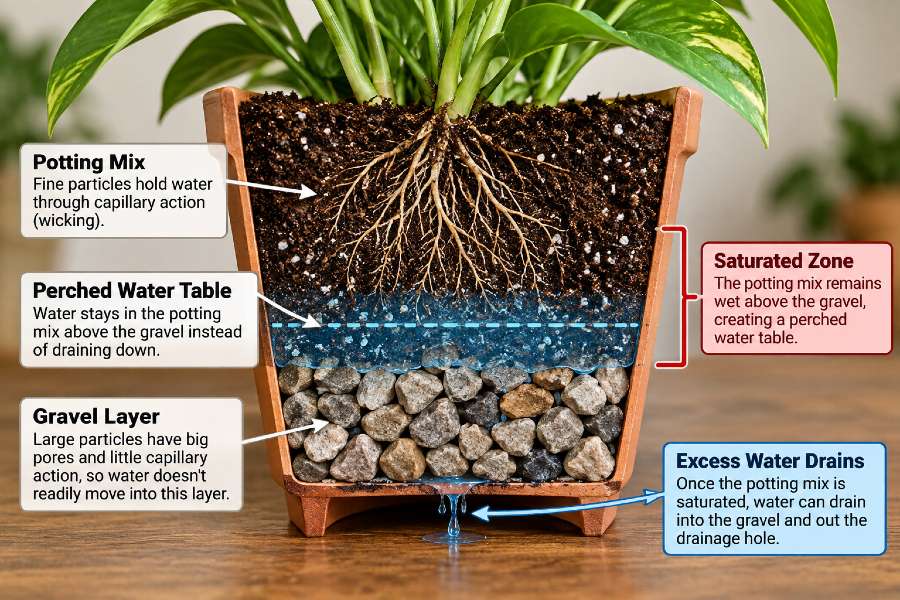
- Gravel in the Bottom of Pots: Does It Improve Drainage? – Why adding gravel or broken pottery beneath your potting mix doesn’t improve container drainage the way many gardeners have been told.
- Humidity for Tropical Houseplants: What Actually Works? – Why misting, pebble trays, and grouping plants aren’t reliable ways to control humidity in a dry room.
The Humidifier I Use for My Houseplants
I use a Lacidoll 8L (2.1-gallon) large room humidifier for my tropical houseplants. I’ve tried several humidifiers over the years, and having a large reservoir makes a big difference for me because I run mine 24/7, especially during the heating season.
The large top-fill tank means I’m not constantly stopping to refill it, and I can adjust the humidity and mist output depending on conditions in the room. I normally aim for around 50% relative humidity, which has worked well for most of the tropical plants I grow.
If you’re shopping for a humidifier for a room full of plants, I’d pay attention to room capacity and reservoir size rather than buying a tiny desktop unit. You want something capable of actually changing the humidity of the room.
Find the Lacidoll 2.1-Gallon Large Room Humidifier on Amazon
References and Further Reading
If you’d like to read more about humidity, houseplants, and indoor growing conditions, these Extension resources are good places to start:
- Penn State Extension – Humidity and Houseplants – A particularly useful look at misting, pebble trays, humidifiers, and how much these methods actually affect humidity.
- University of Illinois Extension – Houseplant Care – Covers humidity and other environmental conditions that affect indoor plants.
- University of Minnesota Extension – Gardening Under Glass – Information about using enclosed growing environments for plants that benefit from higher humidity.
- Washington State University Extension – PNW Gardeners Handbook – Regional information about plant diseases, including conditions associated with powdery mildew in the Pacific Northwest.
 Steve S. is the creator of