Thinking about using a grow tent for vegetables? With just a small space, you can create a thriving indoor garden that delivers fresh harvests year-round.
Discover the benefits and tips on using a grow tent for vegetables – a smart, efficient way to boost your indoor gardening success!
Why Grow Vegetables in a Grow Tent?
- Growing vegetables in a grow tent allows for a controlled environment, enhancing plant growth.
- It ensures stable temperatures, consistent lighting, and protection from pests.
- Grow tents are ideal for urban spaces, enabling year-round gardening regardless of outdoor conditions.
- This method is efficient for various vegetables, offering flexibility and increased yield potential.
Are you thinking about using a grow tent for vegetables? You should. Using an indoor grow tent for vegetables is a great way to turn any indoor space into a vegetable garden.
![Using A Grow Tent For Vegetables [ Easy Quick-start Guide ]](http://indoorvegetablegrower.com/wp-content/uploads/DSCN0377-800x800.jpg)
Using A Grow Tent For Vegetables
Using a grow tent for vegetables can give you a more stable space to start seedlings or grow high-light indoor plants like tomatoes or peppers.
It gives you a dedicated space for your vegetable garden and a way to isolate it from the rest of your apartment.
LED lights are very bright and work much better in a closed environment. Climate is also easier to control in a grow tent.

I use a 48″x24″x60″ grow tent for my seedlings, but it is tall enough to grow larger plants. Grow tents come in many sizes.
So this one works for me, but there are 3×3 and 4×4 tents. There are 4×8, 5X5 and larger tents too but they are more expensive.
Make sure you measure and know how much space you actually have. Most grow tents are measured by their outside dimensions so the inside will be slightly smaller.
When you buy a grow tent it will come unassembled as a grow tent kit but they are not hard to set up. You only need a small space and you won’t need any tools to get it set up.
AC Infinity grow tents are probably the best high end grow tents but they are more expensive. They are a great high-quality option but there are plenty of cheaper grow tents that can do the job.

The reflective material, thickness, and quality of the zippers can affect the price. You want to read reviews and pay attention to what buyers say about any zipper quality issues.
Cannabis growers are concerned with light leaks which can cause flowering plants to reveg. Because it is a high-value crop they can afford to spend more.
But if you are going to grow vegetables it’s not a big deal. So a cheaper grow tent is fine.
If you are just getting started here are some commonly asked FAQs answered for you. Growing Vegetables Indoors For Beginners FAQ (indoorvegetablegrower.com)
Can I use a grow tent for vegetables?
Yes, you can use a grow tent for vegetables. They may even grow better in a properly set up grow tent. You can grow just about any type of plant you can think of.
The best thing about using a grow tent for vegetables is its flexibility. You can set your tent anywhere that is convenient for you.
You can grow big or small plants together or even different plants in a grow tent making your indoor gardening more flexible.
Grow tent uses are unlimited. You can start growing herbs a in grow tent. Strawberries are one of the best fruits to grow in a grow tent. Even growing vining plants like growing cucumbers, and cantaloupe can be trained and trellised in a grow tent.
The reflective walls inside your grow tent will maximize any grow light you are using, and your vegetables will benefit from the increased light.
Other Things You Need
You will need a lighting system. You want to use LED grow lights. They cost less to run and don’t give off a lot of heat.
You will need to provide proper ventilation with an exhaust fan and a second fan to move air inside the tent.
You want to be able to have a controlled environment. With good ventilation and air movement, you can control environmental factors and create the ideal environment for your plant growth.
Can you start seedlings in a grow tent?
You can definitely start seedlings in a grow tent. In fact, that is how I start my seedlings. You can make sure they get enough light and don’t get leggy.
If you are using a good LED grow light you will be fine. You will have enough room to raise or lower your light to meet their needs.
Do plants grow faster in a grow tent?
That is hard to answer because it depends on a lot of things. If your plants have enough light and you maintain a better climate inside your grow tent, then yes, they will grow faster.
You need to understand there is no magic in using a grow tent. What it does is maximize the growth potential of your plants if you maintain a healthy grow environment for them.
That means controlling your light, temperature, and humidity inside your tent. Don’t worry it’s not hard to do, and I will show you how to set up a grow tent for vegetables.
How To Use A Grow Tent For Vegetables
In this video, I take you through how to set up a grow tent for vegetables. I explain my flood and drain system too.
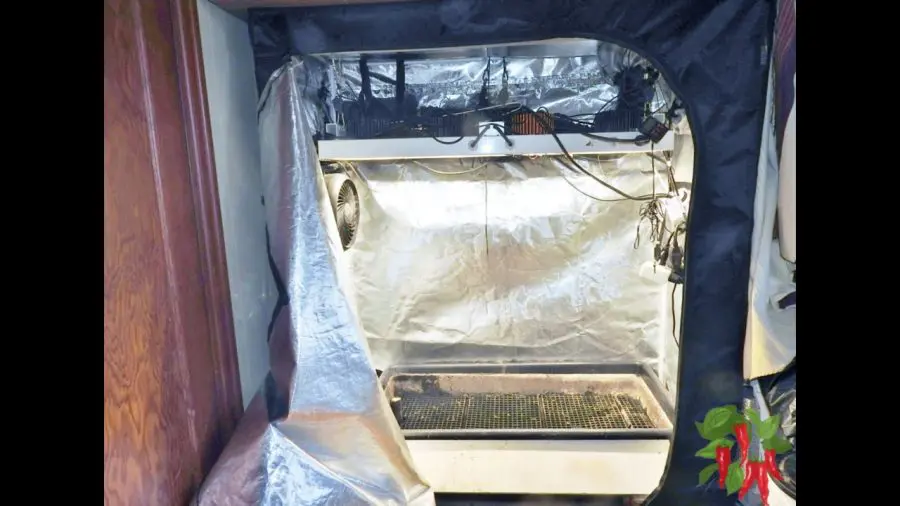
So let’s talk about how to use a grow tent to grow vegetables, and how to set it up. In this video, I am using a 2×4 grow tent and it cost me about 90 bucks.
You’ll notice that the inside of the tent has a reflective covering which makes your light much more effective.
This particular model has a window that you can open to peek in, but i never use it. I just open the zippers if I want to see what’s going on inside.
How To Automate Your Vegetable Grow Tent
If you want to automate your vegetable grow tent, this is how to do it. Otherwise, you can just use pots with a saucer underneath them.
No matter what system you use you will need artificial light inside your grow tent. If you put your light on a timer you can automate your lighting too.
But a hydroponic system like this flood and drain system below will make sure your plants are fed and watered on time. You will see improvement in your crop’s growth rate and higher yields too.
So the best part is you get the best results with automated hydroponic grow tents because once set up your plants always have water, nutrients, and light available.
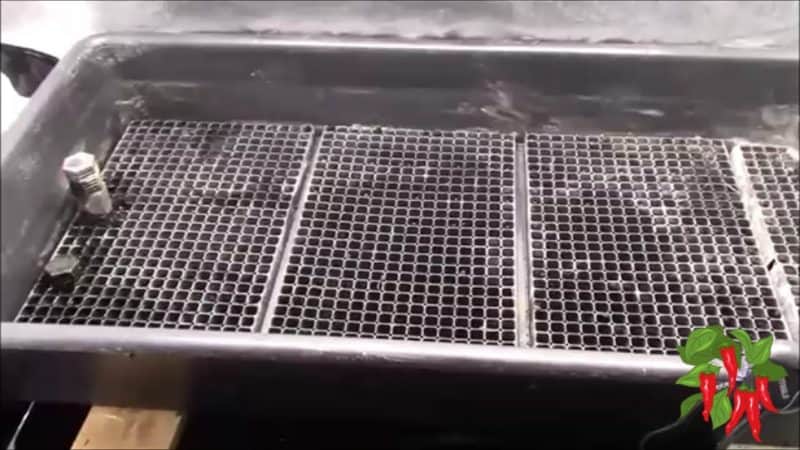
Looking at the above picture, you can see I have a tray in my grow tent, in fact, I actually have 2 of them. Now you don’t have to do it the way I’m going to show you.
But I like to build automated hydroponic systems. So this one is set up for flood and drain sometimes it’s called ebb and flow too.
You can see the two fittings there on the end of the flood tray. The shorter one lets the water come in from the pump.
The taller fitting comes with a bunch of risers you can add to control the flood height. If you look closely, you can see the water mark where the flood height was.
Another thing I do is add these waffle grids. These were seed flats that I cut to fit inside the tray. The reason for that is that there’s always some water remaining in these trays.
If you have a flood tray like a Botanicare flood tray that you can fit in a tent, you won’t need to do that, because they have ridges that drain all the water off. But you can’t get one that fits most grow tents.
Most of these smaller totes have relatively flat bottoms, so the water doesn’t all drain out.
You don’t want your plants sitting in standing water, so that’s why I put these in. Use your ingenuity and find something to keep your plants up so the roots aren’t sitting in water. Egg crate is a good option.
So my automated system has a reservoir underneath the top tray. I use a board to cover up the exposed part of the reservoir so that I don’t get any light in the reservoir.
My reservoir is a two-by-three foot mixing tote that I got from Home Depot for about $13. I have a couple of cross pieces across it that I screwed down so they won’t move.
Then I set another slightly longer but narrower tote on top. Because this tent is only five feet tall I want to keep the height down.
Why I Like Flood And Drain Systems
As I said, I really like flood and drain. It’s automated, it’s easy to set up and all i have to do is drill the two holes for the 2 flood and drain fittings. Right now they cost about 13 bucks.
It’s all up to what you want to do. I check on my plants every day, but I don’t want to water them by hand every day. If I do go somewhere, I know they’re still gonna get watered even if I’m not home.
Want to get away for a week? With a flood and drain system, you can.
My bottom tray is my reservoir. It is a 2 by 3 foot mixing tote that I got at Home Depot, and although they call it a 20-gallon tub, I think it really holds more like 15 unless you fill it to the top,
I also have a pump in the reservoir. The pump I use is an Eco Plus 396 pump and it cost about 35 bucks.
So if you add a couple of trays, the flood and drain fittings, and the pump you are in for about 70-75 bucks. You can build a hydro system like mine or something similar to this pretty cheaply then.
How To Grow Vegetables Without Soil
You can grow vegetables without soil by using hydroton or growstones.
Flood and drain works best with an inert media like hydroton. Some people use rock wool blocks, but I think they hold too much water.
Coco is great for growing vegetables. It works really well in a flood and drain system.
Coco can be a bit messy and get into a reservoir that you really don’t want.
But there is a really simple way to contain it by using fabric pots.
You can also use regular pots. I line my plastic pots with 1-gallon paint strainer bags. Or you can use fabric pots to contain the coco coir.
You don’t need to use large pots for flood and drain, because they never dry out and are fed at regular intervals.
Get More Usable Light In A Grow Tent
You will notice that the inside walls of the grow tent are covered with a reflective coating. This will give your light more bang for its buck.
If you hang a light in an open space, a lot of it does not hit your target. It goes off into the room.
LED grow lights are very bright, and you may not want all that light wafting around your living space.
But grow tent for your vegetables will contain it and make sure none is wasted.
Because in a grow tent there is no escape. All light gets to your plant either directly or by being reflected back to them.
Making Your Grow Tent Waterproof
If you don’t want an automated system you can just use the floor of the tent to grow your veggies there.
But you will need to drain your saucers every time you water. You always want to water until you get run off.
That way, unused nutrients are washed out and replaced. If you don’t you may have salt build up in your pots.
Emptying them can be messy, and spills are likely. Some people use a shop vac to get rid of extra water in their tent.
Before you do this though, there’s one thing that’s important to point out. In my video, you can see there is some white plastic in there.
All grow tents come with a floor insert but it’s not waterproof.
So I really recommend that you line the bottom of your tent with some 4 or 8-mil plastic and bring it up the sides a bit.
That way if you spill water you won’t have any water leaking out because if your tent sits on the floor and water sits in that tray it will eventually leak through.
So I strongly recommend that you add a piece of plastic sheeting and then put that tray on top of it.
Then if you want you can just grow them in pots set them in a saucer to catch the runoff and just hand water. That’s the simplest way to grow vegetables in a tent.
Air Circulation Using A Grow Tent For Vegetables
Maintaining good airflow is important to grow vegetables in a tent. You are going to need a fan to keep the air moving inside the grow tent.
Also in the video, you can see I added a carbon filter ahead of my exhaust fan. You don’t need air filtration systems if you’re only going to grow vegetables.
You will also need an exhaust fan to pull out heat and humidity. This can help control the climate of your vegetables.
From the exhaust fan, you use flexible ducting, and you bring the air out from a built-in ventilation hole. Most grow tents have several and you do need to get the air exhausted from the tent.
Use a fan that is quiet. I am pretty sure you don’t want to sit in your apartment and listen to a loud fan. Some fans can be very loud.
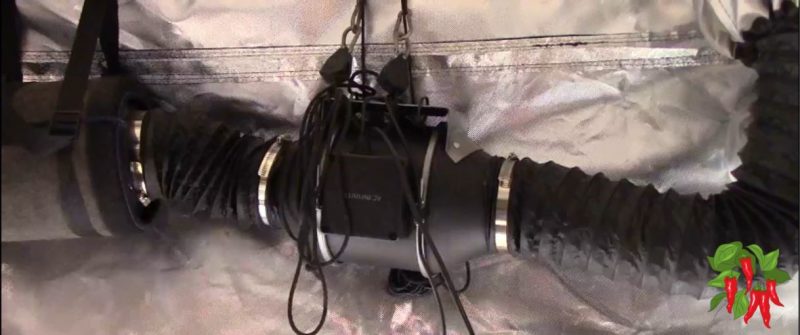
I would also recommend getting a fan that has adjustable fan speed built into it. AC Infinity fans meet both these requirements and are very good fans that are reasonably priced.
Mount your exhaust fan near the top of your tent because heat rises.
You also need a way to get fresh air inside to your plants. All types of plants need CO2 to grow and if you don’t give them fresh air they will use up all the CO2 in the tent and not grow well.
All grow tents have a flap that’s screened to keep bugs out. You can open them up and it’ll pull some air from the bottom.
Then it will go through the fan and get sucked out up top by your exhaust fan and you’re golden now.
Choosing A Grow Light For Grow Tent Vegetables
The first thing you need to know is how many watts a LED grow light actually is. Watts are measured at the wall and not by manufacturer’s numbers.
Many Chinese lights use deceptive wattage numbers. They add up the total wattage of each chip and use that as the wattage.
But most of those lights only use 1/3-1/2 that wattage to run. So always check for how many watts it pulls when plugged in. That is the actual wattage of the light source.
LED Grow Tent Lighting
As far as the lights go, the one in the video is a COB, and you can still get them, but it’s not worth it.
Quantum board-style LEDs are much better. The COBs (chip on board) are more like a spotlight and each COB has hundreds of smaller LED lights embedded in it.
It’s a good spectrum it’s a 35k spectrum so it’s good for veg or flowering but honestly, for the same money, you could get a light that puts out twice the light with less power.
Also, a board with a lot of individual LED diodes will put out more light and give more even coverage. But like all lights, LEDs are brightest in the center and it diminishes around the edges, especially in the corners.
This COB is 250 watts and that’s all you would ever need for a two-by-four tent. So if you get an Led grow light get one that’s dimmable.
You should have a PAR chart from the manufacturer and you can adjust your light by so many inches of height above your plants.
Most of you won’t have a PAR meter and they can be pricey. But you can use an app on your iPhone to measure PAR.
Otherwise, you can raise or lower your light according to your PAR map or you can use a dimmer if you have one.
Plants like tomatoes, cucumbers, and bell peppers need a lot of light. Other plants like lettuce, leafy greens, or herbs don’t need as much.
But it’s important to know you can give your plants too much light also so you want to find that sweet spot.
In my grow closets I only use lights from Horticulture Lighting Group. HLG lights are the best high-performance LEDs you can buy dollar for dollar.
But they are expensive, and if you are growing vegetables, you can use a cheaper light. Their designs have been widely copied. A Spider Farmer Light is very similar but costs much less and that’s what I recommend you use. Growing Vegetables Indoors With Lights [The Truth You Need To Know] (indoorvegetablegrower.com)
A Few More Details About My Grow Tent Setup
You will need a grow light obviously. In my video, I am using an old COB grow light that I bought years ago. It’s 250 watts at the wall and I don’t even turn it all the way up. I use this a lot for seedlings and smaller plants
Also, I took everything out so you could see what it looks like inside. This grow tent has this handy pouch on the side, so I have my power strip in there and I have my timer for my lights plugged into it.
I also have a timer for controlling my watering, and generally, I water two to three times a day for maybe three minutes at a time.
Here these plants are small and usually, they don’t need to be watered a lot. Also, I did add an air pump because you do want to keep your reservoir circulating. You can use a really small pump or you can use an air stone and some use both.
Setting Up Your Grow Tent
Everything is pretty easy to set up. The tents are easy to set up you just follow the directions. They’re often not the greatest, they’re usually in bad English.
But I’m pretty sure you can figure out how to put the metal poles together and make a box. Then you just slip it inside the tent itself. Voila!
The only thing I can say is that I’ve had this for about a year now with no problems.
I had one before and had it for four or five years but the zippers went on it after a while. These are much more lightweight than my original tent but as long as you’re careful with the zippers they should last for years.
You can go out and spend hundreds of dollars on a tent. You can get a gorilla grow tent which is the best there is and it’ll cost you at least three times as much and I really don’t recommend that you do that.
Buy a ninety-dollar tent and if you get a year or two out of it it’s worth it. Then just replace it, that’s what I would recommend
My Recommendations for a 2 x 4 Grow Tent
Here are my recommendations for a 2 x 4 grow tent. If you want a larger tent you will want to upsize your fan to 6 inches and probably get a stronger light too.
Recommended Products
Here are the products discussed in this blog post. I use them all myself and recommend them. Click on the image to see them on Amazon
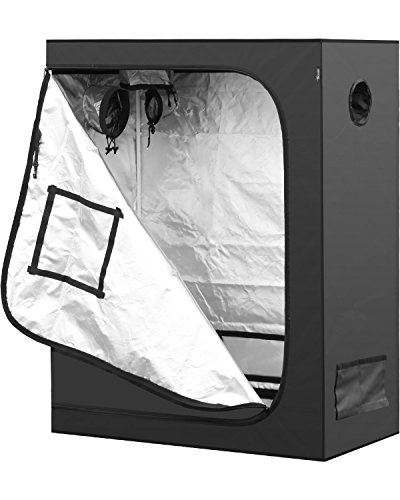
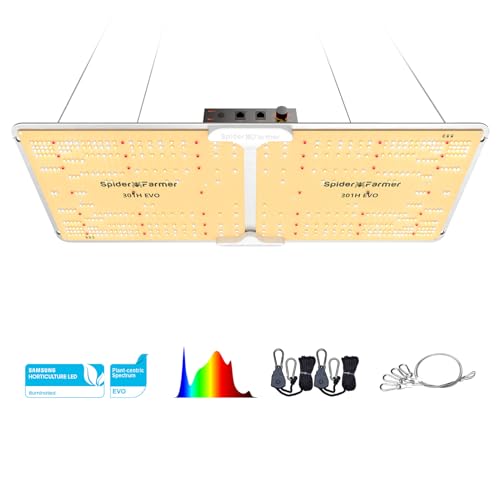

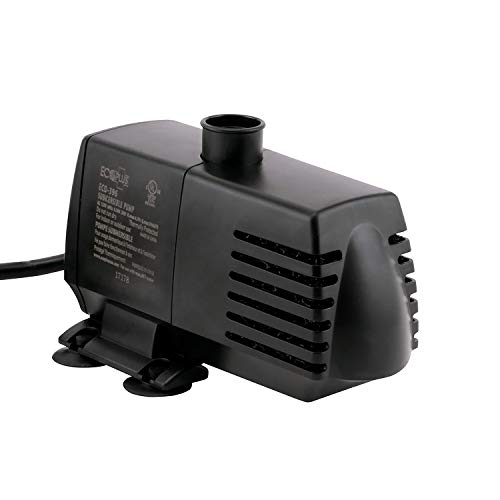 Learn how to use hempy buckets in your grow tent
Here’s your **FAQ section and schema** for the post **“Using A Grow Tent For Vegetables”**, formatted in clean HTML with readable font sizes (22pt for questions, 18pt for answers), followed by a properly structured JSON-LD schema block for SEO.
—
### 🌿 **FAQ Section (HTML)**
“`html
Using A Grow Tent For Vegetables FAQs
Can I use a grow tent for vegetables?
Yes, you can use a grow tent for vegetables. In fact, vegetables often grow better in a properly set up grow tent because you can control the light, temperature, and humidity.
You can grow herbs, greens, strawberries, and even vining crops like cucumbers and cantaloupe by training them on a trellis inside the tent.
The reflective walls help maximize light, creating a more efficient growing environment.
Can you start seedlings in a grow tent?
Absolutely! A grow tent is an ideal place to start seedlings. It allows you to control the light intensity and duration, preventing seedlings from getting leggy.
Using adjustable LED lights ensures young plants receive the right amount of light for healthy growth.
Do plants grow faster in a grow tent?
Yes, if your grow tent environment is properly maintained. With consistent lighting, stable temperatures, and good air circulation, plants can grow faster than those grown in less controlled indoor or outdoor conditions.
Grow tents don’t magically make plants grow faster — they just allow you to optimize the environment for maximum growth.
What size grow tent should I use for vegetables?
A 2×4 or 3×3 grow tent works well for most home gardeners. A 4×4 tent provides more space for larger crops like tomatoes or peppers.
Always measure your available space before purchasing, as most grow tents are sized by their exterior dimensions.
What lighting works best in a grow tent for vegetables?
LED grow lights are the best choice for grow tents because they produce less heat and use less electricity.
Look for dimmable, full-spectrum LEDs like those from Spider Farmer or Horticulture Lighting Group for balanced light coverage and efficient growth.
How do I ventilate a grow tent for vegetables?
Proper ventilation is essential to control temperature and humidity. Use an exhaust fan near the top of the tent to remove warm, moist air, and a small fan inside to keep air circulating.
Fresh air can be drawn in through the lower intake vents to supply CO₂ for your plants.
Can I automate my grow tent setup?
Yes! You can automate lighting, watering, and even ventilation in your grow tent. Using timers for lights and pumps, or setting up a flood-and-drain hydroponic system, ensures your plants receive consistent care even when you’re away.
How can I make my grow tent waterproof?
Line the bottom of your grow tent with thick plastic sheeting (4–8 mil) and bring it a few inches up the sides.
This prevents leaks and protects your flooring from spills. Always use saucers under pots or trays to catch runoff after watering.
What are the advantages of growing vegetables in a grow tent?
Grow tents provide a controlled environment for consistent results, allow for year-round gardening, and reduce exposure to pests and diseases.
They also help you use space efficiently, especially in apartments or small homes, while maximizing light use and yield potential.
💧 Indoor Hydroponic Gardens
Want fresh veggies year-round in small spaces? Explore beginner-friendly hydro systems, closet grow setups, self-watering hacks, and gear reviews that make indoor gardening simple.
-
- 🚪 How to Grow Vegetables in a Closet
- 🧰 How to Turn a Closet into a Grow Room
- 🏕️ Using a Grow Tent for Vegetables
- 🎪 Are Grow Tents Worth It for Vegetables?
- 🏢 Apartment Kitchen Garden: Smart Space Ideas
- 🏙️ Hydroponic Apartment Garden: How to Start
- 🥔 Growing Sweet Potatoes Indoors
- 🧱 Small Closet Grow Room Setup
- See all articles in our Indoor Hydroponic Gardens category
 Steve S. is the creator of