
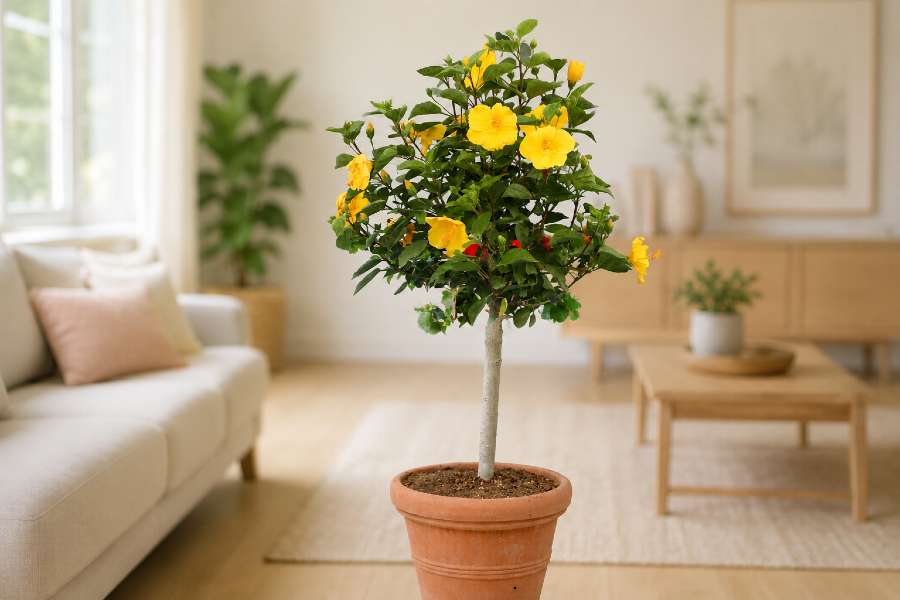
Large houseplants for bright rooms can fill an open corner, soften an empty wall, and give your indoor space a strong natural focal point.
The key is choosing a plant that fits both the available light and the amount of room it will need after several years of growth.
A young plant in a nursery pot may look easy to place, but Tropical Hibiscus, Banana Plants, Rubber Plants, and several indoor trees can eventually reach the ceiling or spread several feet across.
It helps to consider mature height, width, growth rate, and pruning needs before bringing one home.
Bright light also means different things to different plants. Tropical Hibiscus, Avocado, and Majesty Palm need some of the strongest light in this guide.
Ficus, Rubber Plant, Corn Plant, and Bird of Paradise can grow in bright indirect light, although several will benefit from gentle direct sun.
The eight choices in this guide range from relatively forgiving foliage plants to more demanding tropical plants. You can use the comparisons to find a plant that matches your window, available floor space, and normal care routine.
What You’ll Learn
- Which large houseplants grow well in bright rooms
- How much direct or indirect light each plant needs
- How tall and wide each choice can become indoors
- Which plants grow quickly and which require patience
- Which choices can be controlled through pruning
- How much floor space each mature plant requires
- Which large houseplant best matches your care routine
Quick Answer
The best large houseplants for bright rooms include Tropical Hibiscus, Ficus benjamina, Banana Plant, Corn Plant Dracaena, Rubber Plant, White Bird of Paradise, Avocado Tree, and Majesty Palm. Corn Plant, Rubber Plant, Calamondin Orange, and White Bird of Paradise are among the more manageable choices. Tropical Hibiscus, Banana, Avocado, and Majesty Palm need especially strong light and more attentive care.
Large Houseplants for Bright Rooms at a Glance
| Plant | Typical Indoor Size | Light | Growth Rate | Care Level |
|---|---|---|---|---|
| Tropical Hibiscus | Approximately 2–6 feet tall | Very bright light with direct sun | Moderate to fast | Moderate |
| Ficus benjamina | Approximately 6–10 feet tall | Bright indirect light with gentle sun | Moderate | Moderate |
| Banana Plant | Approximately 5–10 feet tall | Very bright light with direct sun | Fast | Moderate |
| Corn Plant Dracaena | Approximately 4–8 feet tall | Medium to bright indirect light | Slow to moderate | Easy |
| Rubber Plant | Approximately 6–10 feet tall | Bright indirect light with gentle sun | Moderate to fast | Easy to moderate |
| White Bird of Paradise | Approximately 6–10 feet tall | Bright indirect light with some gentle sun | Moderate | Easy to moderate |
| Avocado Tree | Approximately 5–10 feet tall with pruning | Very bright light with direct sun | Moderate to fast | Moderate |
| Calamondin Orange Tree | Approximately 3–6 feet tall | Very bright light with direct sun | Moderate | Moderate |
| Majesty Palm | Approximately 6–10 feet tall | Very bright light with some direct sun | Moderate | Demanding |
A note about plant size: These are practical indoor estimates rather than fixed limits. The exact cultivar, container size, pruning, light, plant age, and growing conditions will all influence the plant’s eventual height and width.
What Counts as a Bright Room?
A bright room receives dependable natural light for much of the day, but that does not automatically mean every location in the room is bright enough for a large plant. Light intensity drops quickly as you move away from the window.
South- and southwest-facing windows generally provide the strongest indoor light in the Northern Hemisphere. East-facing windows provide gentler morning sun, while west-facing windows can become hot during summer afternoons.
Trees, roof overhangs, window screens, nearby buildings, and curtains can all reduce the usable light. A room that appears bright to you may still provide limited growing light in a corner several feet from the glass.
Bright Indirect Light vs. Direct Sun
Bright indirect light illuminates the plant strongly without direct rays remaining on the foliage for an extended period. Direct sunlight reaches the leaves without being blocked by curtains, buildings, or trees.
Ficus, Corn Plant, and Rubber Plant can grow well in bright indirect light. Tropical Hibiscus, Banana Plant, Bird of Paradise, Calamondin Orange, Avocado, and Majesty Palm generally need stronger exposure and may benefit from several hours of direct sun.
Introduce a plant to stronger sunlight gradually. A specimen grown in a shaded greenhouse or dark store display can develop scorched foliage if it is immediately placed against a hot south- or west-facing window.
1. Tropical Hibiscus
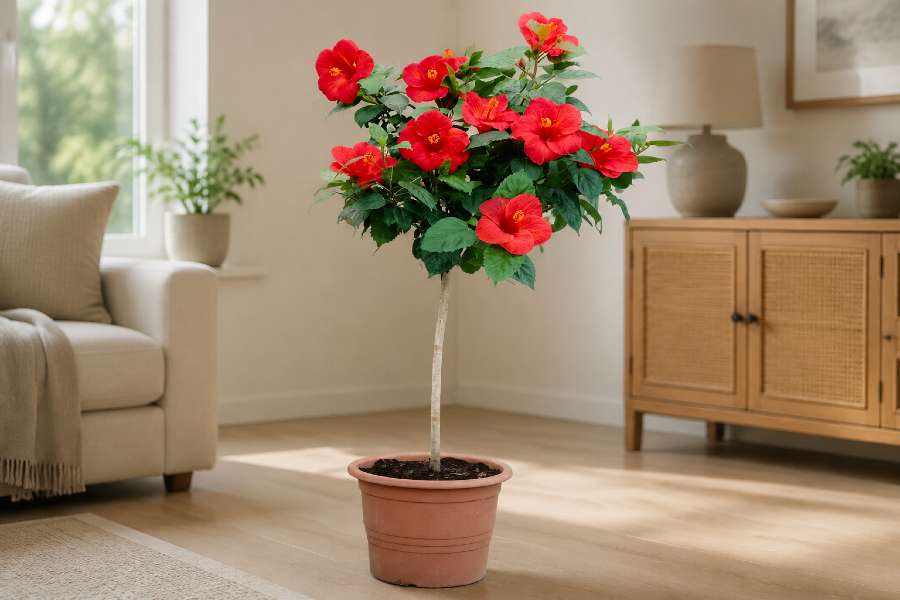
Tropical Hibiscus, Hibiscus rosa-sinensis, combines the presence of a large floor plant with colorful flowers. Its glossy foliage forms a full shrub, while the flowers may appear in shades of red, orange, yellow, pink, white, or combinations of several colors.
This is one of the best choices when your bright room includes a sunny south- or southwest-facing window. Hibiscus needs considerably more light to flower well than a Corn Plant or Ficus grown mainly for its foliage.
Why Tropical Hibiscus Works in a Bright Room
A healthy Hibiscus can grow several feet tall and develop into a substantial flowering shrub. It gives you height, dense foliage, and large flowers without requiring the ceiling space needed by an indoor Banana Plant.
The individual flowers may only last a short time, but a vigorous plant can continue producing buds during active growth. Strong light, consistent watering, and regular feeding support that flowering cycle.
Light and Placement
Place Tropical Hibiscus directly in front of your brightest window. Several hours of direct sunlight will generally produce better flowering than bright indirect light alone.
Watch the potting mix closely near a sunny window. A large leafy plant can use water quickly during warm weather, particularly while producing flowers.
Size and Space Requirements
Tropical Hibiscus commonly grows approximately 2 to 6 feet tall indoors. Regular pruning can maintain a shorter, bushier plant, although it will still need more horizontal space than a narrow upright tree.
Give the foliage enough room to remain clear of walls and neighboring plants. Good airflow around the canopy can also make it easier to inspect for aphids, whiteflies, and spider mites.
Read my complete guide to Tropical Hibiscus care indoors for detailed information about watering, feeding, pruning, and flowering.
2. Ficus Benjamina
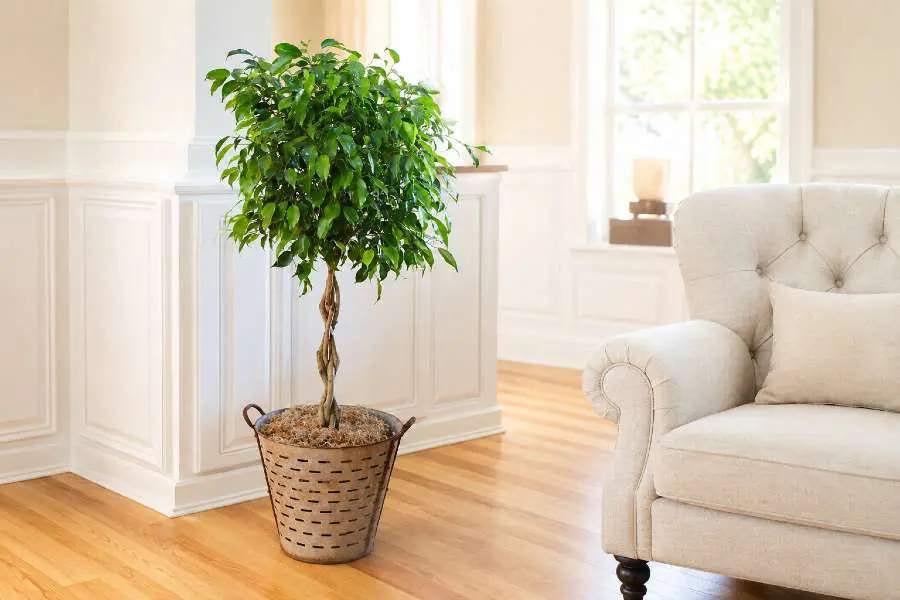
Ficus benjamina, commonly called Weeping Fig, develops slender branches covered with glossy pointed leaves. A mature specimen has the familiar shape of a small indoor tree and can fill vertical space without producing extremely broad leaves.
It grows best in bright, consistent light. It can adapt to bright indirect conditions, but stronger light generally supports denser foliage and more balanced growth.
Why Ficus Benjamina Works in a Bright Room
Ficus benjamina gives you the appearance of a branching tree rather than a clump of foliage rising directly from the pot. This makes it useful beside a sofa, in a dining area, or near an open wall that needs height.
You can prune the branches to maintain the desired shape and height. Regular light pruning also encourages a fuller canopy instead of a few long, sparse stems.
Light and Placement
Position the plant near an east-, south-, or west-facing window where it receives bright indirect light and possibly some gentle direct sun. Protect it from an abrupt move into intense sunlight if it was previously grown in dimmer conditions.
Ficus benjamina prefers a stable location. Sudden changes in light, temperature, or watering can trigger leaf drop, so choose its permanent position carefully before the plant becomes large and difficult to move.
Size and Space Requirements
An indoor Ficus benjamina can reach approximately 6 to 10 feet tall when given a large container and favorable conditions. Pruning can keep it shorter and encourage a more compact canopy.
The width depends heavily on how the plant is trained. A single-trunk specimen may remain relatively narrow, while a multi-stemmed plant can spread several feet across.
See my complete guide to growing Ficus benjamina indoors for more information about its light, watering, soil, feeding, and pruning needs.
3. Indoor Banana Plant
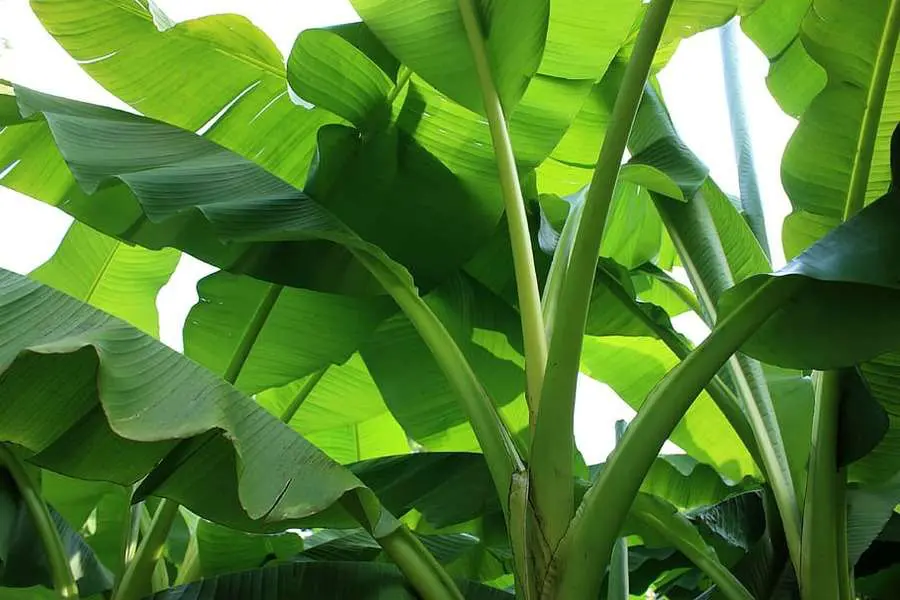
An indoor Banana Plant creates an immediate tropical effect with its long stems and enormous paddle-shaped leaves. It grows more quickly than many indoor trees and can transform an open, sunny room in a relatively short period.
Banana Plants need plenty of light, warmth, moisture, and growing space. They are best for someone who wants vigorous growth and has enough room for leaves that can extend well beyond the container.
Why a Banana Plant Works in a Bright Room
Few indoor plants produce large tropical foliage as quickly as a Banana Plant. A healthy plant can add significant height and width during a single growing season.
Dwarf cultivars are the most practical indoor choices. Even a dwarf Banana Plant can become substantial, so the word “dwarf” should not be mistaken for a small tabletop plant.
Light and Placement
Place an indoor Banana Plant close to a south- or southwest-facing window where it can receive very bright light and several hours of direct sun. A powerful grow light may be needed during dark winters or when the window is partially obstructed.
Rotate the container periodically so growth remains balanced. The large leaves naturally turn toward the strongest light source and can cause the plant to lean.
Size and Space Requirements
Depending on the species or cultivar, an indoor Banana Plant may grow approximately 5 to 10 feet tall. Some compact varieties remain shorter, while vigorous plants can approach the ceiling.
The leaves require just as much consideration as the height. A mature leaf can extend several feet from the center of the plant and may split when it rubs against furniture, walls, or other plants.
Read my complete guide to growing a Banana Plant indoors for detailed care instructions.
4. Corn Plant Dracaena

Corn Plant, Dracaena fragrans, produces upright cane-like stems topped with clusters of long, arching leaves. Its narrow growth habit provides useful height without requiring as much width as Banana Plant, Bird of Paradise, or Majesty Palm.
This is the most adaptable plant in this guide. It grows well in bright indirect light but does not require the direct sun needed by Tropical Hibiscus or Avocado.
Why Corn Plant Works in a Bright Room
Corn Plant is a good choice when you want a tall floor plant that remains relatively easy to manage. Its upright canes fit into spaces where the spreading leaves of a Banana Plant or palm would crowd furniture and walkways.
Varieties with yellow, cream, or lime-green striping develop their strongest color in bright indirect light. The plant can tolerate lower light, but its growth may slow and variegation can become less distinct.
Light and Placement
Place Corn Plant near an east-facing window or several feet from a bright south- or west-facing window. Filter prolonged direct sunlight with a sheer curtain to prevent pale or scorched patches.
Unlike several plants in this guide, Corn Plant does not need to sit directly against your brightest window. This gives you more flexibility when filling an open corner that receives strong ambient light.
Size and Space Requirements
Corn Plant commonly grows approximately 4 to 8 feet tall indoors. Its relatively narrow canopy can make it look tall without occupying an excessive amount of floor space.
You can shorten an overly tall cane by cutting it at the desired height. New shoots may develop below the cut, producing a fuller plant with multiple growing points.
Read my complete Corn Plant Dracaena care guide for detailed growing instructions.
5. Rubber Plant
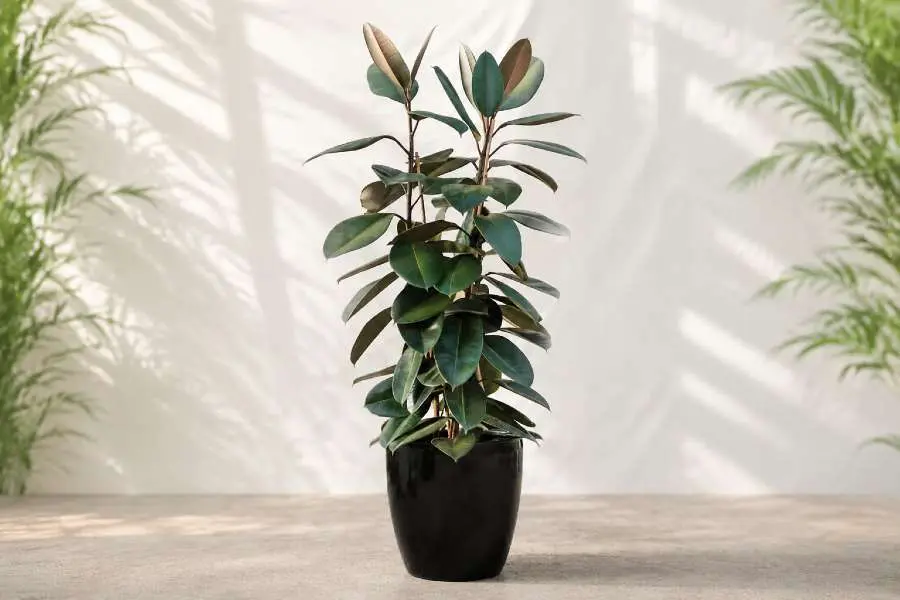
Rubber Plant, Ficus elastica, develops thick stems and large glossy leaves. Depending on the variety, the foliage may be deep green, burgundy, or variegated with cream, green, and pink.
It provides the height of an indoor tree with leaves that are bolder and broader than those of Ficus benjamina. A healthy Rubber Plant can grow quickly when it receives strong light and consistent care.
Why Rubber Plant Works in a Bright Room
Rubber Plant is one of the more manageable large houseplants. Its thick leaves handle ordinary household humidity better than the delicate fronds of Majesty Palm, and it does not require constantly moist soil.
The plant naturally tends to grow upward from a central stem. Pruning can encourage branching when you want a fuller, more tree-like shape.
Light and Placement
Provide bright indirect light and some gentle direct sun. An east-facing window or a filtered south- or west-facing exposure can support strong growth.
Variegated Rubber Plants need more light than solid green varieties because their leaves contain less chlorophyll. A dark location may cause variegated growth to lose color or become weak and widely spaced.
Size and Space Requirements
Rubber Plant can grow approximately 6 to 10 feet tall indoors. Pruning and container size can help maintain a plant that fits beneath the ceiling.
A single-stem plant remains fairly narrow, while a pruned and branching specimen needs more horizontal room. Rotate the container periodically to prevent the stem and leaves from leaning heavily toward the window.
Use my complete Rubber Plant care guide for more information about light, watering, pruning, and repotting.
6. Bird of Paradise
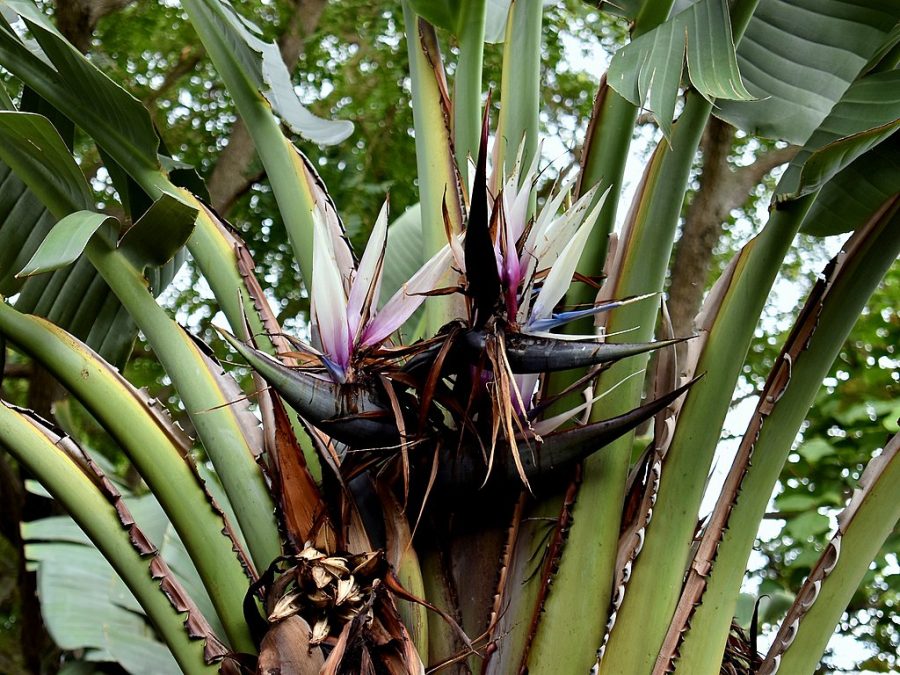 NasserHalaweh, CC BY-SA 4.0, via Wikimedia Commons
Bird of Paradise produces tall stems topped with broad, paddle-shaped leaves. Its strong upright growth and bold foliage make it one of the most recognizable statement plants for a bright living room, sunroom, or open office.
Two species are commonly grown indoors. Orange Bird of Paradise, Strelitzia reginae, is the smaller flowering species. White Bird of Paradise, Strelitzia nicolai, grows much larger and is more commonly sold as a substantial indoor foliage plant.
White vs. Orange Bird of Paradise
White Bird of Paradise, Strelitzia nicolai, and Orange Bird of Paradise, Strelitzia reginae, have similar paddle-shaped leaves but develop into noticeably different plants. White Bird of Paradise grows taller, produces larger leaves, and is commonly used as a substantial indoor foliage plant.
Orange Bird of Paradise remains smaller, generally needs stronger light, and is the better choice when flowers are your main goal. Its familiar orange and blue blooms are more likely to appear under very bright conditions, although flowering can still be difficult indoors.
For this guide, White Bird of Paradise is the more practical choice. It reaches the large size we are looking for, adapts more readily to bright indirect indoor light, and remains attractive even when it never flowers.
Why Bird of Paradise Works in a Bright Room
Bird of Paradise creates a tropical appearance similar to a Banana Plant, but its leaves are supported on firm individual stems that form a more structured clump.
A mature specimen can fill a large empty corner and provide enough visual impact to serve as the main plant in the room. It needs considerably more light and space than a Corn Plant.
Light and Placement
Place Bird of Paradise close to a south-, southwest-, or bright west-facing window. It grows best with several hours of direct sunlight after it has been gradually acclimated.
Rotate the container periodically because the stems and leaves will turn toward the strongest light. A plant kept too far from the window may develop weak, leaning stems and produce smaller leaves.
Size and Space Requirements
Orange Bird of Paradise commonly reaches approximately 4 to 6 feet indoors. White Bird of Paradise may grow 6 to 10 feet tall or more under favorable conditions.
The broad leaves require considerable room around the plant. Natural splitting along the leaf edges is common and does not necessarily indicate poor care. The splits help large leaves tolerate air movement without tearing completely away from the stem.
7. Indoor Avocado Tree
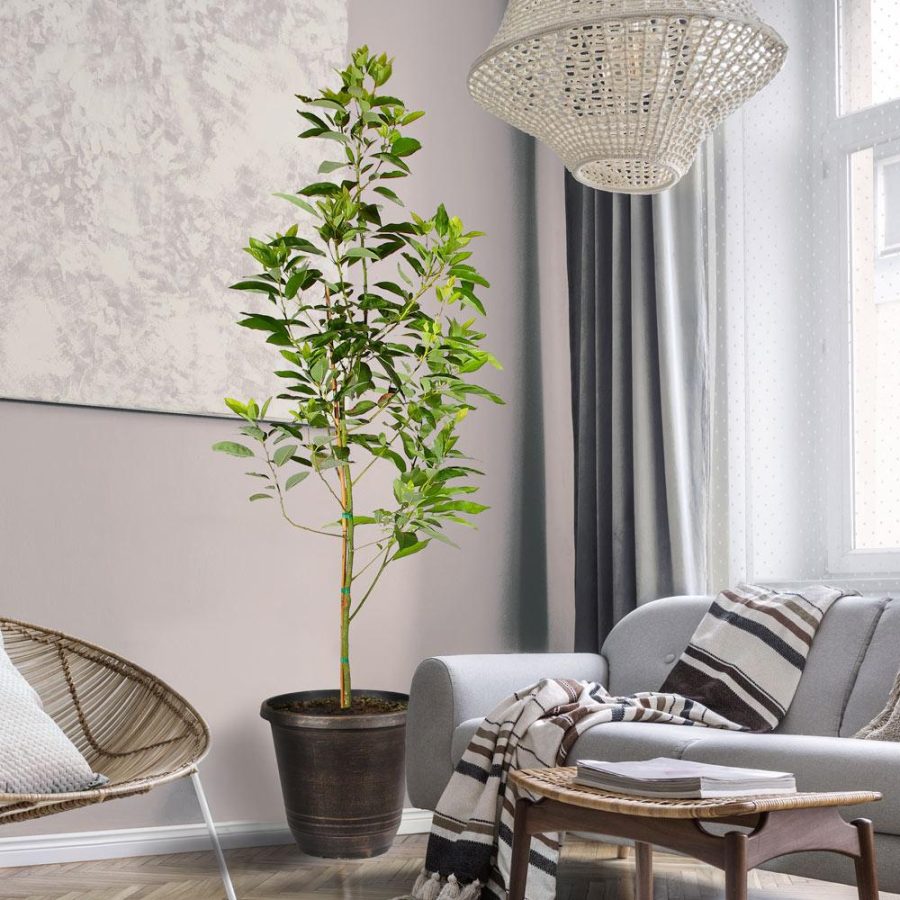
Avocado, Persea americana, can be grown indoors as a leafy subtropical tree. You can begin one from a pit, but a nursery-grown grafted tree will usually develop a stronger shape and has a better chance of eventually producing fruit.
Even with a grafted tree, indoor fruit production is not guaranteed. Avocado is best treated as an attractive foliage tree unless you can provide exceptional light, warmth, pollination, and growing space.
Why Avocado Works in a Bright Room
Avocado develops a recognizable branching tree form and responds well to pruning. Its fresh green leaves create a lighter, more open canopy than the dense foliage of a Rubber Plant.
This is a useful choice when you enjoy shaping plants and do not mind pruning regularly. Without pruning, an indoor seed-grown Avocado can become tall and narrow rather than developing a full canopy.
Light and Placement
Place an Avocado Tree directly beside a south- or southwest-facing window. It needs several hours of sunlight to maintain compact growth and strong stems.
A grow light may be needed during winter, particularly in northern climates. An Avocado grown with inadequate light often stretches toward the window and develops long spaces between its leaves.
Size and Space Requirements
An indoor Avocado Tree may be maintained at approximately 5 to 10 feet tall through regular pruning. Its natural outdoor size is much larger, so size control needs to begin while the plant is young.
Pinching or pruning the growing tips encourages branching and helps prevent a single thin stem from reaching the ceiling. Choose a heavy container that can support the plant as its trunk and canopy develop.
Read my complete Indoor Avocado Tree care guide for detailed light, watering, soil, pruning, and container advice.
8. Calamondin Orange Tree

8. Calamondin Orange Tree
Calamondin Orange, Citrus × microcarpa, is one of the best citrus trees for growing indoors. It develops glossy evergreen leaves, fragrant white flowers, and small orange fruit on a naturally compact plant.
The fruit looks like a miniature orange but has a tart, acidic flavor. It is commonly used in drinks, sauces, marmalade, and cooking rather than eaten like a sweet orange.
Why Calamondin Orange Works Indoors
Calamondin adapts to container growing better than many larger citrus trees and can flower and fruit while remaining a manageable size. A healthy tree may carry flowers and ripening fruit at the same time, making it an especially attractive choice for a sunny room.
Choose a grafted nursery tree rather than starting one from seed. A grafted plant will usually flower and fruit sooner and is more likely to maintain a compact, productive shape.
Light and Placement
Place Calamondin directly beside a south- or southwest-facing window where it can receive at least six hours of strong light each day. A powerful grow light may be needed during winter, particularly in northern climates.
Calamondin can tolerate ordinary indoor conditions better than some citrus trees, but flowering and fruiting still depend heavily on abundant light. Rotate the container periodically to encourage a balanced canopy.
Size and Space Requirements
A container-grown Calamondin Orange Tree can usually be maintained at approximately 3 to 6 feet tall. Light pruning helps preserve a compact branching shape and keeps the tree from becoming too wide for its location.
Its canopy remains narrower and easier to manage than Banana Plant, White Bird of Paradise, or Majesty Palm. This makes Calamondin a practical fruiting tree for a sunny apartment, bright kitchen, or sunroom.
Read more: growing a Calamondin Orange Tree indoors
Read my complete guide to growing Citrus Trees indoors for detailed information about light, watering, soil, feeding, pollination, and fruit production.
9. Majesty Palm
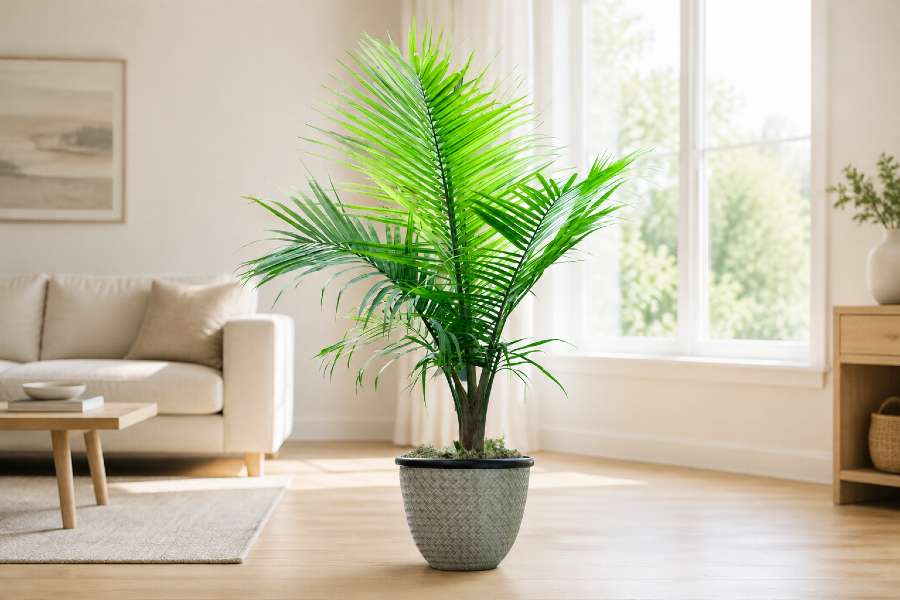
Majesty Palm, Ravenea rivularis, produces long, arching fronds that create an immediate tropical display. It is commonly sold as a houseplant, even though maintaining one indoors requires more attention than its widespread availability suggests.
This palm belongs in a large, bright room where its fronds have room to spread. It needs abundant light, consistent moisture, moderate to high humidity, and regular monitoring for spider mites.
Why Majesty Palm Works in a Bright Room
A healthy Majesty Palm can fill a substantial area with soft, feathery foliage. It creates a full display more quickly than waiting for a small Kentia Palm to grow into a large specimen.
Its popularity also makes large nursery-grown plants relatively easy to find. However, Majesty Palm should be selected because you have suitable conditions, not simply because an inexpensive specimen looks impressive at the store.
Light and Placement
Give Majesty Palm one of the brightest locations in your home. A large east-facing window, a very bright filtered south-facing window, or a sunroom can provide useful light.
The palm can benefit from gentle direct sun, but introduce stronger sunlight gradually. Fronds grown under store or greenhouse shade can scorch if they are moved immediately into intense afternoon sun.
Low light is one of the main reasons Majesty Palms decline indoors. A location several feet inside a room may look bright but still provide too little usable light to maintain dense green fronds.
Size and Space Requirements
Majesty Palm commonly reaches approximately 6 to 10 feet tall indoors and may become larger under favorable conditions. Its arching fronds can spread four feet or more across.
Height is only part of the space requirement. Position the palm where its fronds will not constantly brush against a wall, curtain, furniture, or people passing through the room.
Read my complete Majesty Palm care guide before deciding whether your indoor conditions can support this beautiful but demanding palm.
Which Large Houseplant Is Easiest to Grow?
Corn Plant Dracaena is the easiest overall choice in this guide. It adapts to a wider range of indoor light, grows at a manageable rate, and maintains a relatively narrow shape.
Rubber Plant is another strong choice when you have brighter light. It grows faster than Corn Plant but handles average household humidity better than Majesty Palm or Banana Plant.
My Beginner Picks: Choose Corn Plant when you want an adaptable, upright floor plant. Choose Rubber Plant when you have stronger light and want larger, glossier foliage with faster growth.
Which Plant Makes the Biggest Statement?
Banana Plant and Bird of Paradise produce the boldest individual leaves. Both need plenty of light and enough horizontal room for their foliage to spread.
Majesty Palm creates a softer, fuller display with numerous arching fronds. Tropical Hibiscus adds the strongest flower color, while Ficus benjamina provides the most familiar indoor-tree shape.
Choose Based on Your Available Floor Space
For a Narrower Location
- Corn Plant Dracaena
- Single-stem Rubber Plant
- Pruned Ficus benjamina
- Young Avocado Tree
These plants still need room to grow, but their upright or prunable forms make them easier to control than plants with enormous leaves or spreading fronds.
For an Open Corner
- Tropical Hibiscus
- Branching Rubber Plant
- Ficus benjamina
- Orange Bird of Paradise
For the Largest Open Spaces
- Indoor Banana Plant
- White Bird of Paradise
- Majesty Palm
These plants need enough width for large leaves or arching fronds. They work best in sunrooms, open living areas, spacious offices, and other locations where the foliage will not obstruct a walkway.
Choose Based on the Light You Have
Bright Indirect Light
- Corn Plant Dracaena
- Ficus benjamina
- Rubber Plant
These are the most practical choices when the room is bright but the plant will not receive several hours of direct sunlight.
Very Bright Light With Some Direct Sun
- Tropical Hibiscus
- Indoor Banana Plant
- Bird of Paradise
- Indoor Avocado Tree
- Majesty Palm
- Calamondin Orange
These plants should remain close to a bright window. A grow light may be needed if outdoor shade, nearby buildings, or short winter days substantially reduce the available light.
Shared Care Tips for Large Houseplants
These plants share a need for dependable light and enough room to grow, but they should not all receive the same watering, soil, or humidity routine. A large container and large leaves do not automatically mean a plant wants constantly wet soil.
Check the Potting Mix Before Watering
Large plants can use a surprising amount of water during active growth. Banana Plant, Tropical Hibiscus, Bird of Paradise, and Majesty Palm generally need more consistent moisture than Ficus, Rubber Plant, Corn Plant, or Avocado.
Check the potting mix with your finger rather than automatically watering on a particular day. Light, temperature, humidity, plant size, container material, and the time of year all influence how quickly a large plant dries.
When watering, moisten the entire root ball and allow excess water to escape through the drainage holes. Empty any water that collects in the saucer or decorative outer pot.
Use an Airy, Well-Draining Potting Mix
A large container filled with dense potting mix can remain wet for a long time. That makes drainage and root-zone aeration especially important.
I commonly use coco coir as the moisture-retentive part of my indoor potting mixes. Perlite adds drainage and creates air spaces around the roots. A small amount of fine orchid bark can provide additional structure for tropical foliage plants.
Adjust the mixture for the plant. Majesty Palm, Banana Plant, and Tropical Hibiscus appreciate more consistent moisture. Rubber Plant, Ficus, Corn Plant, and Avocado benefit from allowing the upper portion of the mix to dry before watering again.
Choose a Stable Container
A mature floor plant can become top-heavy, particularly when its canopy leans toward a window. Choose a container that is wide and heavy enough to support the plant without tipping.
Do not compensate by placing a small root ball into an enormous pot. Unused potting mix may remain wet much longer than the roots need. Move up one container size when repotting unless the plant has an unusually large or vigorous root system.
Rotate Plants for Balanced Growth
Most indoor plants grow toward their strongest light source. Rotate the container approximately one-quarter turn every week or two to encourage balanced growth.
Rotating is particularly useful for Banana Plant, Bird of Paradise, Rubber Plant, and Avocado. Stop or reduce rotation if the plant responds poorly to frequent changes in orientation.
Provide Humidity Based on the Plant
Majesty Palm, Banana Plant, Tropical Hibiscus, and Bird of Paradise appreciate moderate to high humidity. Dry air can contribute to brown edges, damaged new growth, and spider mite problems.
Corn Plant, Rubber Plant, and Ficus generally adapt more readily to ordinary household humidity. A room humidifier is the most dependable solution when your indoor air remains very dry.
Fertilize During Active Growth
Large plants need nutrition to support new leaves and stems, but fertilizer cannot compensate for inadequate light. Feed moderately during spring and summer when you can see active growth.
Use a fertilizer appropriate for the plant and follow its label. Majesty Palm benefits from a fertilizer formulated for palms, while Tropical Hibiscus may benefit from a product intended for flowering plants.
Reduce or stop feeding during winter when growth slows. Applying fertilizer to dry potting mix or damaged roots can cause additional stress.
Prune Before the Plant Reaches the Ceiling
Ficus benjamina, Rubber Plant, Tropical Hibiscus, Corn Plant, Calamondin Orange and Avocado can all be pruned to control height and encourage branching. Begin shaping the plant while it is still manageable instead of waiting until it reaches the ceiling.
Banana Plant, Bird of Paradise, and Majesty Palm do not respond to height-control pruning in the same way. Their older or damaged leaves and fronds can be removed, but cutting the top does not create a shorter, branching plant.
Can You Move Large Houseplants Outside for Summer?
Many of these plants benefit from spending warm weather outdoors. Stronger light, natural humidity, and improved airflow can encourage vigorous growth.
Wait until nighttime temperatures are reliably warm. Begin in a shaded outdoor location and gradually introduce the plant to brighter conditions over one or two weeks.
Do not move a plant directly from indoor light into full summer sun. Even Hibiscus, Banana, Avocado, Bird of Paradise, and Majesty Palm can develop scorched foliage when the change is too sudden.
Check the plant carefully for insects before bringing it back indoors. Pay particular attention to the undersides of leaves, leaf joints, stems, and the surface of the potting mix.
Are These Large Houseplants Safe for Pets?
Pet safety varies among the plants in this guide. Common names can also cause confusion, so confirm the botanical name before placing any large plant where a pet can chew it.
- Ficus benjamina: The ASPCA lists it as toxic to cats and dogs. Its sap can cause digestive and skin irritation.
- Corn Plant Dracaena: Dracaena species are considered toxic to cats and dogs.
- Rubber Plant: Ficus elastica contains an irritating milky sap and should be kept away from pets. Do not confuse it with the pet-safe American Rubber Plant, Peperomia obtusifolia.
- Bird of Paradise: The ASPCA lists Strelitzia reginae as toxic, with the fruit and seeds presenting the greatest concern.
- Avocado: Avocado contains persin, and the pit presents an additional choking or intestinal obstruction risk.
- Banana Plant and Majesty Palm: These are generally considered among the safer choices, although chewing any plant material can still cause digestive upset.
Tropical Hibiscus safety can vary depending on which plant is being sold under the common name. Verify that your plant is Hibiscus rosa-sinensis and check a reliable pet-safety source for the exact species.
You can search plants by botanical name using the ASPCA Toxic and Non-Toxic Plant Database.
Common Mistakes With Large Houseplants
Choosing Based on the Nursery-Pot Size
A young Banana Plant, Bird of Paradise, or Majesty Palm may fit comfortably in your car and beside the window. Its mature foliage can occupy several feet of width.
Measure the available height and width before purchasing. Include enough clearance for leaves and fronds to remain out of walkways.
Placing a High-Light Plant in a Bright-Looking Corner
A room may appear bright while a corner several feet from the window receives very little usable growing light. Tropical Hibiscus, Banana, Bird of Paradise, Avocado, and Majesty Palm should remain close to a strong light source.
Giving Every Plant Direct Sun
Not every plant in a bright room needs prolonged direct sunlight. Corn Plant can scorch in intense sun, while Ficus and Rubber Plant should be introduced to direct light gradually.
Repotting Into a Container That Is Too Large
An oversized pot holds a large volume of unused potting mix. That mix can remain saturated and reduce the amount of oxygen reaching the roots.
Choose a container only slightly larger than the current root ball and use a loose, well-draining mix.
Ignoring the Width of the Plant
Ceiling height receives plenty of attention, but leaf and frond spread often causes problems first. Majesty Palm, Banana Plant, and Bird of Paradise may fit beneath the ceiling while still blocking a window or extending into a walkway.
Waiting Too Long to Begin Pruning
Ficus, Rubber Plant, Hibiscus, Corn Plant, and Avocado are easier to shape while they are young. Early pruning encourages branching and prevents the plant from becoming tall, narrow, and difficult to manage.
Assuming a Large Plant Needs Frequent Watering
Plant size alone does not determine when it needs water. A large Rubber Plant in a cool room may dry more slowly than a smaller Hibiscus growing against a sunny window.
Check the potting mix and consider the plant species before watering.
Frequently Asked Questions
What is the easiest large houseplant for a bright room?
Corn Plant Dracaena is the easiest overall choice because it adapts to a wider range of light and ordinary household conditions. Rubber Plant is another manageable option when you can provide bright indirect light.
Which large houseplant grows the fastest?
Banana Plant is one of the fastest-growing choices under warm, bright conditions. Tropical Hibiscus and Rubber Plant can also grow quickly during spring and summer.
Fast growth means the plant may need more water, fertilizer, repotting, and space than a slower-growing Corn Plant or Ficus.
What is the best large plant for direct sunlight indoors?
Tropical Hibiscus, Banana Plant, Bird of Paradise, and Avocado are among the strongest choices for a sunny indoor window. Acclimate each plant gradually before exposing it to prolonged direct sun.
Which large houseplant takes up the least floor space?
Corn Plant Dracaena has one of the narrowest growth habits. A single-stem Rubber Plant or carefully pruned Ficus benjamina can also provide height without producing the broad spread of Banana Plant or Majesty Palm.
Can a large houseplant stay several feet from the window?
Corn Plant, Ficus benjamina, and a solid-green Rubber Plant have more placement flexibility than the high-light plants in this guide. However, the suitable distance depends on the window’s size, direction, outdoor shade, curtains, and season.
Tropical Hibiscus, Banana Plant, Bird of Paradise, Avocado, and Majesty Palm should generally remain near the brightest available window or receive supplemental light.
Final Thoughts on Large Houseplants for Bright Rooms
The best large houseplant is one that fits the light and space you already have. A healthy mature plant can transform an empty corner, but it needs enough room for its canopy, leaves, or fronds to develop naturally.
Corn Plant is my easiest recommendation for dependable height and relatively narrow growth. Rubber Plant is another practical choice when you want bold glossy leaves and have stronger indirect light.
Tropical Hibiscus gives you colorful flowers, while Ficus benjamina provides the familiar structure of a branching indoor tree. Avocado is well suited to growers who enjoy pruning and shaping their plants.
Banana Plant and Bird of Paradise create the boldest tropical foliage, but both need abundant light and considerable space. Majesty Palm produces a beautiful full display when you can provide the light, moisture, humidity, and attention it requires.
Before buying, measure the intended location and watch how sunlight moves through the room. Choosing for mature size now can save you from having to rearrange the entire room later.
Where to Go Next
Explore More Indoor Plant Choices
References
- University of Minnesota Extension: Lighting for Indoor Plants
- Clemson Cooperative Extension: Indoor Plant Light, Containers and Fertilizing
- Penn State Extension: Palms as Houseplants
- ASPCA: Toxic and Non-Toxic Plant Database

 Steve S. is the creator of